
The Dangote Tomato Plant, Africa's Import Crisis, and the Long Road to Processing Sovereignty
- Wilbert Frank Chaniwa
- 3 days ago
- 11 min read

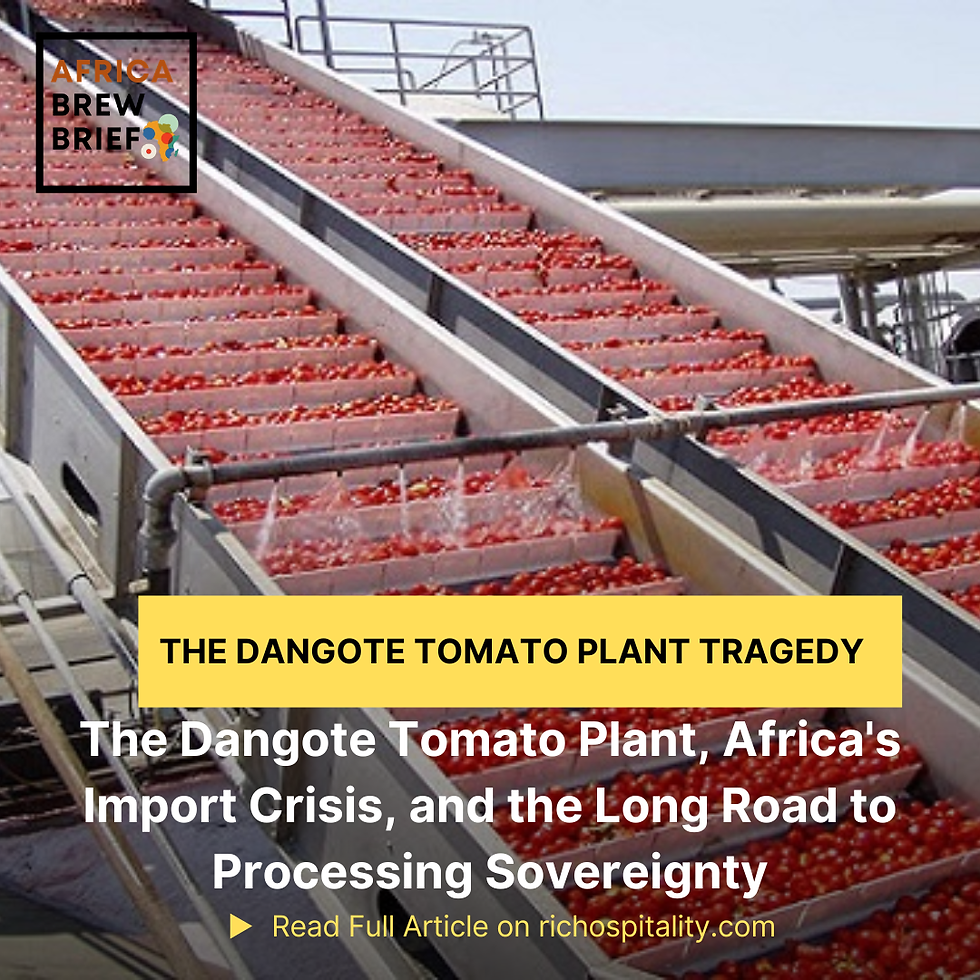
Africa Brew Brief | RIC Brands Intelligence Series
---
There is a crop growing across West Africa's northern savannahs that should be making people rich. It is bright red, high in lycopene, consumed daily in hundreds of millions of kitchens, and traded globally in a market worth over $12 billion annually. Nigeria alone produces an average of 2.3 million metric tonnes of it every year — more than 65 percent of all the tomatoes grown across West Africa. And yet, every year, Nigeria writes a cheque — a very large cheque — to China.
In 2025, Nigeria spent over $350 million importing tomato paste from China and the United States. By April 2026, the Nigerian Export Promotion Council put the figure even higher, disclosing at a technical workshop in Kano that the country spends over $400 million annually on tomato paste importation. [The Whistler](https://thewhistler.ng/tomato-rich-revenue-poor-why-nigeria-cant-tap-into-12bn-global-market/amp/) The story of how that number got so large, and what it will take to bring it down, is one of the most instructive case studies in African agribusiness — and the Dangote tomato processing plant sits at the very heart of it.
---
## The Scale of Africa's Tomato Import Crisis
To understand what is at stake, you have to first understand just how much processed tomato Africa is consuming — and how little of it originates on the continent.
The African market for tomato pastes is divided into four regions of very unequal importance. West Africa is by far the most active consumer region, with imports accounting for an average of more than 61 percent of the continent's total supplies over the last eleven years. Mediterranean Africa accounts for almost 21 percent, Southern Africa for just under 13 percent, and East Africa for less than 5 percent of the total. [Tomato News](https://tomatonews.com/africa-volumes-and-value-of-the-paste-market/)
From 2013 to 2023, China accounted for an average of 70 percent of Africa's foreign purchases of tomato pastes. China and Italy together accounted for an average of 88 percent of African spending on tomato pastes — between USD 395 and 665 million per year. [Tomato News](https://tomatonews.com/africa-volumes-and-value-of-the-paste-market/)
The trajectory is sobering. While volumes fell by 30 percent between 2016 and 2022, imports surged again in 2023 to around 505,000 tonnes. Although 11 percent lower than the pre-COVID average of 566,000 tonnes, those 2023 imports cost African consumers 23 percent more — totalling over USD 589 million. [Tomato News](https://tomatonews.com/africa-volumes-and-value-of-the-paste-market/) Africa is buying less paste, but paying far more for it.
Libya, Ghana, Nigeria, Algeria, and South Africa make up the top five African buyers of tomato puree in the global market, with imports ranging between USD 25 million and USD 90 million each. [Tomato News](https://tomatonews.com/the-processing-tomato-market-in-africa/)
Meanwhile, the processing gap remains vast. While globally around 25 percent of the average harvest of 180 million tonnes is processed, that figure drops to less than 15 percent in Africa. [Tomato News](https://tomatonews.com/the-processing-tomato-market-in-africa/) The continent sits on a surplus of raw tomatoes while simultaneously importing the processed derivative. This is the defining contradiction of African agribusiness: producing the raw material and outsourcing the value.
Nigeria exemplifies the paradox most sharply. Nigeria ranks as the second largest tomato producer in Africa. However, its annual production of 3.6 million tonnes falls short of meeting domestic consumption needs, and to fulfil local demand, Nigeria imports roughly 150,000 tonnes of tomato paste concentrate each year. [Sahelconsult](https://sahelconsult.com/wp-content/uploads/2024/05/Sahel_Quarterly_Exploring-the-Constraints-Innovations-and-Opportunities-in-Nigerias-Tomato-Value-Chain-Development-v4.pdf) The country grows the tomato, loses the tomato, and then imports the paste.
---
## The Post-Harvest Crisis: Where the Red Gold Bleeds Out
Before any processing conversation can begin, there is a brutal upstream reality to confront. Nigerian farmers currently produce approximately 1.5 million tons of tomatoes each year, but around 900,000 tons — more than half — end up rotting due to a lack of storage, processing, and transport infrastructure. [FW Africa](https://www.foodbusinessafrica.com/dangote-group-launches-africas-largest-tomato-processing-facility-in-nigeria/)
50 percent of fresh tomatoes produced yearly in Nigeria are lost to post-harvest challenges, including poor supply chain management manifesting in inefficient storage facilities and poor transportation systems. [Businessday NG](https://businessday.ng/news/article/smuggling-high-cost-of-energy-halt-dangote-tomato-paste-production/)
These numbers describe a supply chain that collapses before it begins. Smallholder farmers — who grow the vast majority of Nigeria's tomatoes across states like Kano, Kaduna, and Katsina — harvest at peak season, flood a fragmented local market, watch prices crash, and then watch their produce rot in open markets and on trucks because there is nowhere to take it and no cold chain to preserve it. The informal trade that does occur is enormous: a 2025 OECD report found that when unrecorded trade is factored in, the regional West African tomato market nearly quadruples to USD 111 million annually — far exceeding official statistics. [Ecofin Agency](https://www.ecofinagency.com/news/2103-53972-west-africa-s-hidden-tomato-trade-and-the-limits-of-official-data)
This is not merely a logistics problem. It is a structural failure of value capture at origin — one that costs Nigerian farmers hundreds of millions in lost income every single year, and costs the Nigerian economy in the form of a bloated import bill.
---
## Dangote Steps In: The Anatomy of a $20 Million Bet
When Aliko Dangote — Africa's wealthiest man and one of its most consequential industrial investors — turned his attention to tomatoes, he framed the problem with characteristic directness. "This factory not only meets domestic demand but sets a benchmark for what Nigerian agriculture can achieve," he said at the plant's unveiling. "Investing in our own production is not just a business strategy; it's a commitment to Nigeria's future."
Launched in March 2016 with a $20 million investment, the Dangote tomato processing facility is located in Kadawa, Kano State, covers 17,000 hectares, and boasts a daily processing capacity of 1,200 tonnes of tomatoes and an annual capacity of 400,000 tonnes. [Tomato News](https://tomatonews.com/the-processing-tomato-market-in-africa/)
The infrastructure investment was substantial and deliberately integrated. The plant was built by Swiss agribusiness giant Syngenta, is the size of 10 football pitches, and sits alongside 17,000 hectares of irrigated fields. [Financialnigeria](https://www.financialnigeria.com/dangote-group-launches-n4-billion-tomato-factory-in-kano-sustainable-photovideo-details-373.html) Alongside the main plant, Dangote established a N3 billion greenhouse nursery in Kano, designed to produce between 300 and 350 million hybrid tomato seedlings annually, aimed at supplying farmers with high-quality seedlings to strengthen Nigeria's tomato production base. [FW Africa](https://www.foodbusinessafrica.com/dangote-group-launches-africas-largest-tomato-processing-facility-in-nigeria/)
The farmer economics built into the model were intentionally disruptive. The plant sources raw tomatoes directly from farmers in the Kadawa Valley, paying a guaranteed price of $700 per ton — nearly double the usual market average of $350 — offering farmers a stable income and helping curb rural-to-urban migration. [MSME Africa](https://msmeafricaonline.com/dangote-group-launches-africas-largest-20-million-tomato-processing-plant-to-boost-nigerias-agriculture-cut-imports/) The factory was designed to directly employ about 120 people but engage over 50,000 tomato farmers in the surrounding area. [Financialnigeria](https://www.financialnigeria.com/dangote-group-launches-n4-billion-tomato-factory-in-kano-sustainable-photovideo-details-373.html)
On paper, this was the blueprint for African agro-industrial transformation: local investment, upstream farmer integration, guaranteed offtake pricing, and downstream import substitution — all in one facility.
---
## The Unvarnished Reality: Structural Barriers and a Dormant Plant
Here is where the Africa Brew Brief must be honest — because this story is not yet a triumph. It is a cautionary tale about what happens when processing infrastructure is built without resolving the structural supply chain problems beneath it.
The Kadawa factory was designed to process 1,200 tonnes of tomatoes a day, requiring approximately 40 truckloads of fresh tomatoes daily to run at capacity. It never consistently ran at capacity. [The Whistler](https://thewhistler.ng/tomato-rich-revenue-poor-why-nigeria-cant-tap-into-12bn-global-market/amp/) The factory shut down in late 2017, barely a year and a half after launch, due to a lack of raw materials and a price dispute between the company and farmers. It remained idle for over two years before resuming in March 2019, and then shut down again by September of that year when farmers abandoned tomato cultivation at the onset of the rainy season for more reliable crops. [The Whistler](https://thewhistler.ng/tomato-rich-revenue-poor-why-nigeria-cant-tap-into-12bn-global-market/amp/)
The plant has since stood dormant, described by its own former managing director as unable to compete with Chinese imports that contain starch, flour, and as little as 10 percent tomato content, sold at prices far below what locally sourced, 100 percent tomato production can match. The high cost of energy and fresh tomatoes made operations commercially unviable. [Businessday NG](https://businessday.ng/news/article/smuggling-high-cost-of-energy-halt-dangote-tomato-paste-production/)
The Kadawa factory, once described as a beacon for Nigeria's agricultural transformation, now stands dormant and unable to compete with cheap substandard imports and crippling operational costs. The Dangote experience has had a chilling effect on private investment in Kano's tomato processing sector. [The Whistler](https://thewhistler.ng/tomato-rich-revenue-poor-why-nigeria-cant-tap-into-12bn-global-market/amp/)
The structural problems are several and interconnected. First, tomato supply in northern Nigeria is deeply seasonal, making consistent factory throughput almost impossible without cold storage infrastructure that does not yet exist at scale. Second, pest outbreaks — particularly Tuta absoluta — routinely devastate crops with little coordinated government response. A 2025 outbreak in Kano saw 4,621 hectares of tomato farms put at risk, with the All Farmers Association of Nigeria warning that inaction could result in losses of between N10 billion and N20 billion. [The Whistler](https://thewhistler.ng/tomato-rich-revenue-poor-why-nigeria-cant-tap-into-12bn-global-market/amp/) Third, the dumping of low-quality, low-price tomato paste — much of it from China, containing minimal actual tomato content — makes domestic processing economically uncompetitive without robust border enforcement or tariff protection.
---
## What Comes from a Tomato: The Full Value Chain
To appreciate how much economic value is being left on the table, it helps to understand how broad the tomato processing opportunity actually is. The tomato is not a one-product crop.
Industrial tomato processing yields a range of distinct products across multiple market categories:
**Concentrate and Paste.** Double concentrate (28–30% soluble dry matter) and triple concentrate (35%+) are the highest-volume products globally, used as inputs in food manufacturing, catering, and household cooking. Algeria, for instance, has seen triple concentrate production surge from 9,000 tonnes in 2013 to over 70,000 tonnes in 2021 through a deliberate national strategy. [Tomato News](https://tomatonews.com/the-processing-tomato-market-in-africa/)
**Canned Whole and Diced Tomatoes.** Processed at harvest and sealed for shelf stability — a premium product commanding higher unit values in retail markets.
**Tomato Juice and Tomato Beverages.** A growing category, especially in health-conscious consumer markets where lycopene and antioxidant content are being marketed actively.
**Tomato Powder and Flakes.** Dehydrated formats with long shelf life, used extensively in the food service, snack, and seasoning industries.
**Tomato Ketchup and Sauces.** The highest branded value-add tier, where margin is greatest and brand equity compounds over time.
**Lycopene Extract.** An industrial nutraceutical and pharmaceutical input derived from tomato processing byproducts, used in health supplements and functional foods.
**Tomato Seed Oil.** Extracted from processing waste seeds, with applications in cosmetics and specialty food sectors.
Each of these product tiers represents a different market, a different price point, and a different export opportunity. Africa currently competes in almost none of them at scale.
---
## The Trade Opportunity: What Africa Is Missing
The global processed tomato market is valued at over $12 billion annually. Nigeria participates minimally, and Kano — sitting at the centre of northern tomato cultivation — is missing its share entirely. [The Whistler](https://thewhistler.ng/tomato-rich-revenue-poor-why-nigeria-cant-tap-into-12bn-global-market/amp/)
The AfCFTA architecture creates a transformative market context for any African nation that can build genuine processing capacity. Preliminary estimates show that intra-African exports would increase by 109%, led by manufactured goods, especially if implementation of the AfCFTA is accompanied by robust trade facilitation measures. [Brookings](https://www.brookings.edu/articles/the-future-of-african-trade-in-the-afcfta-era/) Processed tomato products — paste, concentrates, sauces — sit squarely in the manufactured goods category that AfCFTA is designed to accelerate.
Intra-African trade rose to $192.2 billion in 2023, a 3.2 percent increase from the previous year, increasing the share of formal intra-African trade from 13.6 percent in 2022 to 14.9 percent in 2023. [Brookings](https://www.brookings.edu/articles/intra-african-trade-and-its-potential-to-accelerate-progress-toward-the-sdgs/) The trajectory is upward, but the baseline remains low — and agri-processing is one of the sectors best positioned to drive it higher.
The West African tomato trade alone signals the depth of unmet intra-regional demand. Tomatoes are a major item in intra-African trade. In West Africa, Burkina Faso annually exports nearly 150,000 tonnes of tomatoes to coastal countries including Ghana and Benin, generating annual revenues of CFA50 billion (USD 83.5 million). [Tomato News](https://tomatonews.com/the-processing-tomato-market-in-africa/) That is raw tomato trade. The processed derivative trade is an order of magnitude larger — and is currently flowing to China and Italy instead of between African nations.
Any country or agribusiness capable of building reliable processing capacity, at competitive cost, with consistent quality output, and aligned to AfCFTA preferential tariff schedules, faces a ready continental market with structurally growing demand and a foreign import bill waiting to be intercepted.
---
## What Africa Can Learn from the Dangote Experience
The Dangote tomato plant is not a failure story. It is a first-mover story — and the lessons it carries are arguably more valuable precisely because they were learned at cost.
**1. Processing infrastructure cannot precede supply chain infrastructure.** The single most important lesson from Kadawa is that a factory without a reliable, year-round supply of raw materials is just a building. Cold chain investment, aggregation centres, irrigation, and pest management must be developed in parallel with — or before — processing capacity. Ethiopia's flower industry and Morocco's tomato export sector both demonstrate that upstream farm infrastructure determines downstream processing viability.
**2. Farmer economics must be structurally viable, not just nominally attractive.** Dangote's $700-per-tonne guaranteed price was double the market rate — but farmers still abandoned the relationship when rainy-season crop economics shifted. Long-term offtake agreements backed by input financing, crop insurance, and extension services create the farmer loyalty that spot pricing cannot.
**3. Policy must protect domestic processors from dumped imports.** Chinese tomato paste imports containing as little as 10 percent tomato content are sold at prices that make locally sourced, 100 percent tomato production commercially unviable. [Businessday NG](https://businessday.ng/news/article/smuggling-high-cost-of-energy-halt-dangote-tomato-paste-production/) No processing investment can survive in that environment without either import tariffs, quality standards enforcement, or both. Ghana, Tunisia, and Algeria have each deployed varying degrees of import substitution policy to protect their domestic processing sectors.
**4. The integrated model is the only viable model.** Dangote's combination of the processing plant, the greenhouse nursery, and the farmer network is structurally correct. The failure was in execution and in underestimating the supply chain gap. The blueprint itself — vertical integration from seedling to paste — is the right architecture for African agro-processing.
**5. Scale requires patient capital and government partnership.** A $20 million processing plant cannot absorb the full structural cost of building a tomato value chain from scratch. DFI co-investment, concessional credit, government-backed farm input programmes, and infrastructure spending on rural roads and water must accompany private sector processing investment. Nigeria's central bank provides concessional credit to processors, yet utilisation lags because raw fruit supply remains erratic [Mordor Intelligence](https://www.mordorintelligence.com/industry-reports/tomato-market) — which confirms that financing supply alone does not close the gap.
**6. Quality standards are a competitive weapon.** The ability to produce high-Brix, additive-free tomato concentrate — authentically African in origin — is a differentiated value proposition in European, Middle Eastern, and increasingly Asian premium markets. The Dangote plant's 100 percent tomato content, which made it uncompetitive against dumped Chinese paste domestically, is exactly the premium that commands margin internationally.
---
## The Road Forward
Nigeria has the land, the climate, the farmers, and — demonstrated by the Dangote investment itself — the private sector ambition to become a tomato processing powerhouse. Africa is the fastest-growing region in the global tomato market, with a 4.8 percent CAGR, anchored by Egypt's drip-irrigated harvest and Nigeria's policy push to substitute hundreds of millions in paste imports. [Mordor Intelligence](https://www.mordorintelligence.com/industry-reports/tomato-market)
Egypt's trajectory is instructive. Egypt expanded its use of drip irrigation to 120,000 hectares in 2024, resulting in a production increase to 6.7 million metric tonnes and a boost in exports to European and Middle Eastern buyers. [Mordor Intelligence](https://www.mordorintelligence.com/industry-reports/tomato-market) The infrastructure investment preceded the processing scale-up. That sequencing matters.
For Nigeria to unlock its tomato potential, five things must happen simultaneously: cold chain infrastructure must be built at the farm gate; pest management must be treated as a national food security priority; import standards for tomato paste must be enforced to eliminate adulterated products; AfCFTA-aligned export strategy for processed tomato must be developed; and DFI capital must be channelled into integrated agro-processing complexes rather than isolated factory investments.
The global tomato market is not waiting for Africa to figure this out. China, Italy, Spain, and the United States are supplying Africa's own demand back to it — at a cost that now exceeds $400 million a year in Nigeria alone.
Aliko Dangote was right about the vision. The Kadawa plant proved that the investment case exists. What it also proved is that the investment case cannot be realised in isolation from the supply chain, the policy environment, and the farmer ecosystem that must support it.
Africa does not need to import its own red gold. It needs to process it, brand it, and sell it — to itself first, and then to the world.
---
*Africa Brew Brief | RIC Brands — RIC Brands' intelligence platform tracking African agribusiness, coffee trade, and origin stories. Follow the brief: https://share.google/vnz8ZqMf6ujiKPr4j |


Comments