
Iru - The Natural Cooking Cube - The Fermented Seed Africa Forgot to Brand
- Wilbert Frank Chaniwa
- 4 hours ago
- 9 min read

What Exactly Is the Product
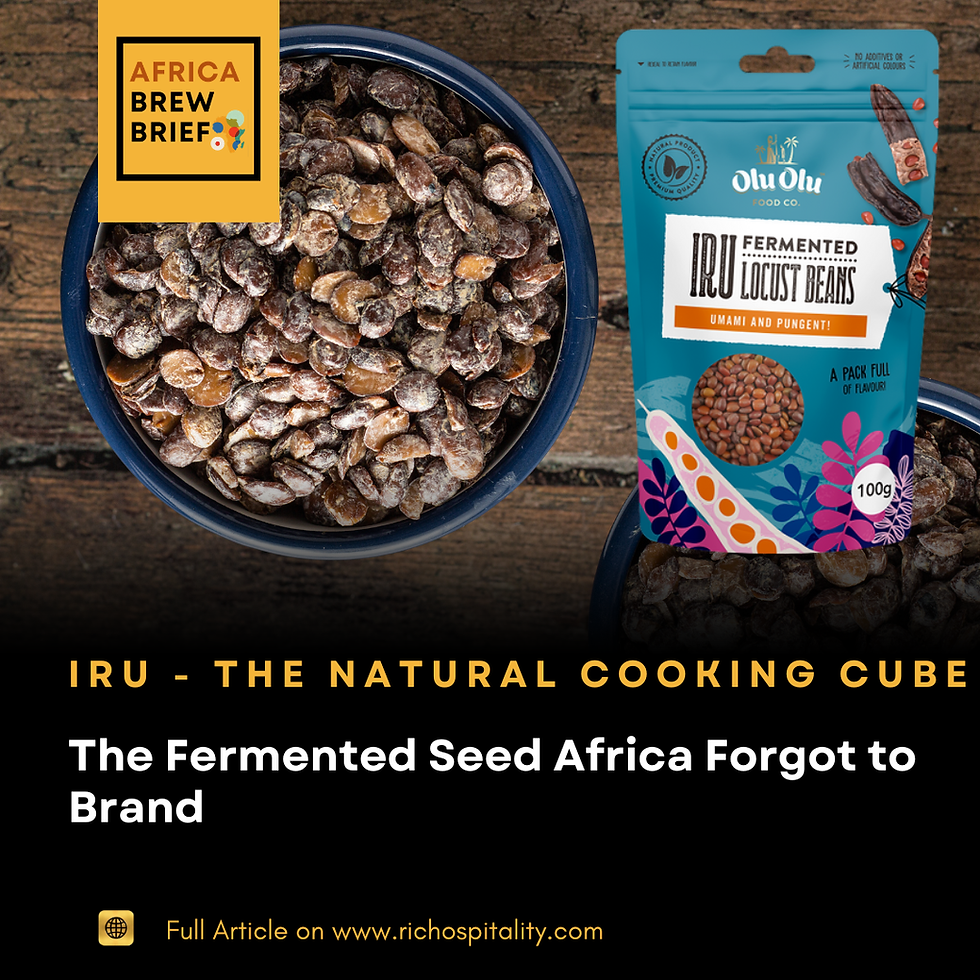
Iru is the Yoruba name for a fermented condiment made from the seeds of *Parkia biglobosa*, the African locust bean tree — known regionally as dawadawa (Hausa), soumbala (Manding/Mali/Burkina Faso), netetou (Wolof, Senegal), afitin or sonru (Benin), kpalugu (Dagomba/Kusasi, northern Ghana), and nere in Burkina Faso. It is a dense, aromatic paste produced by rural women who collect pods from the tree and ferment the seeds into a protein-rich condiment that underlies much of West African cuisine, delivering an umami depth often described as a meat substitute in diets short on animal protein. [ResearchGate](https://www.researchgate.net/publication/261626103_African_Locust_Bean_Parkia_species_and_its_West_African_fermented_food_product_dawadawa)
Botanically, Parkia biglobosa is a perennial deciduous tree in the Fabaceae family, found across a wide range of African environments and grown chiefly for its pods, which contain both a sweet pulp and the valuable seeds that are crushed and fermented into the condiment [iNaturalist](https://www.inaturalist.org/taxa/133528-Parkia-biglobosa) [Wikipedia](https://en.wikipedia.org/wiki/Parkia_biglobosa) . The tree is indigenous to the Sahelian region of West Africa, flowering and fruiting during the hottest months, and virtually every part of it — fruit, seed, and bark — carries traditional use: the pulp is eaten fresh or blended into drinks, and the bark is processed into paint or burned into ash used for alkaline fermentation. [Eat with Afia](https://eatwithafia.com/what-are-fermented-locust-beans-iru-dawadawa/)
Nutritionally, the raw material is genuinely potent. Analysis of the fruit pulp shows roughly 6.6% protein, 67% carbohydrate, nearly 12% crude fiber, and notably high vitamin C content (around 191 mg/100g), while the fermented seed itself is more than sufficient to meet FAO/WHO recommended daily protein allowances for a healthy adult. [ResearchGate](https://www.researchgate.net/publication/230123756_Incubation_and_fermentation_of_African_locust_beans_Parkia_biglobosa_in_production_of_dawadawa) Fermentation is the transformation engine: the process degrades anti-nutritive factors, improves digestibility, and raises concentrations of vitamins, minerals, and essential amino acids — including methionine, phenylalanine, leucine, and isoleucine — beyond what the raw seed offers. [ResearchGate](https://www.researchgate.net/publication/230123756_Incubation_and_fermentation_of_African_locust_beans_Parkia_biglobosa_in_production_of_dawadawa) Iru is also a meaningful source of riboflavin (Vitamin B2), a nutrient many rural Nigerian diets under-supply. [Academic Journals](https://academicjournals.org/journal/AJMR/article-full-text/D038C8863637) This is not folklore seasoning — it is a functional protein and micronutrient carrier that happens to also taste extraordinary.
## History of Production
The tree itself predates the nation-states that now claim it. Parkia biglobosa is native to the West African savannah stretching from Senegal to Cameroon and has been used by human communities across that belt for millennia [Figaro Shakes](https://figaroshakes.com/cultural-ferments/dawadawa-recipe-west-african-fermented-locust-bean-condiment-iru-guide/) , long before the trans-Saharan and Atlantic trade corridors that later moved cola nut, gold, and salt through the same region. The fermentation technique — boil, dehull, ferment — is one of Africa's oldest indigenous biotechnologies, refined by generations of women who never called it biotechnology but understood exactly which conditions produced a safe, stable, flavorful product.
Traditional processing is genuinely labor-intensive. The seeds are dehulled after long hours of boiling — a step widely noted as the most time- and energy-consuming stage of the process. [ResearchGate](https://www.researchgate.net/publication/230123756_Incubation_and_fermentation_of_African_locust_beans_Parkia_biglobosa_in_production_of_dawadawa) Grokipedia's synthesis of the technical literature is precise on sequence: seeds are boiled for 24–29 hours to soften them, dehulled, boiled again for 4–5 hours, then left to ferment anaerobically for two to five days at around 40°C — a process driven primarily by *Bacillus subtilis* and *Bacillus pumilus*, which break proteins down into flavorful peptides and ammonia while reducing anti-nutritional compounds. The result is dried, often molded into balls or discs, and ground for use. [Grokipedia](https://grokipedia.com/page/Parkia_biglobosa) Mass-balance research on the process is equally specific: one kilogram of raw beans yields about 1.3 kilograms of processed substrate, which converts to roughly 1.2 kilograms of finished dawadawa, with losses coming from pulp, testa removal, and solids lost in boiling and washing water. [Wiley Online Library](https://scijournals.onlinelibrary.wiley.com/doi/abs/10.1002/jsfa.2740370312)
Crucially, this has never been a marginal cottage practice. In Burkina Faso, over half of respondents in a nationwide survey said they participate in the néré (locust bean) trade, and while men and women share equally in selling the dry seed, women hold exclusive control over the sale of the fermented product itself. [Wikipedia](https://en.wikipedia.org/wiki/Parkia_biglobosa) The condiment carries identity as much as flavor: in Plateau State, Nigeria, dawadawa connects ethnic groups such as the Ngas, Berom, Anaguta, Miango, and Mangu to a shared West African fermentation heritage, and despite the spread of commercial bouillon cubes, many households still prefer it for its natural flavor and health value. [The Esan People](https://www.oriire.com/article/fermentation-in-african-food-traditions-the-case-of-parkia-biglobosa-in-plateau-state-nigeria)
## Uses of the Product
**Culinary.** Dawadawa/iru is used in small quantities to season soups, stews, rice dishes, and sauces across Nigeria, Ghana, Senegal, Mali, Burkina Faso and beyond — as ordinary and indispensable to West African cooking as soy sauce is to East Asia, consumed daily by millions of people. [Figaro Shakes](https://figaroshakes.com/cultural-ferments/dawadawa-recipe-west-african-fermented-locust-bean-condiment-iru-guide/) In Yoruba cooking it anchors ewedu, gbegiri, ogbono, and efo riro; in the Sahel, soumbala performs the same function in tô sauces and millet-based dishes.
**Medicinal and functional.** Indigenous healers across West Africa use different parts of the tree for treating conditions including hypertension, wounds, and malaria; a Togo survey of traditional healers found Parkia biglobosa among the most frequently cited medicinal plants, and it was one of two plants documented with genuine wound-healing activity through stimulating dermal fibroblast proliferation in southwestern Nigeria. [Wikipedia](https://en.wikipedia.org/wiki/Parkia_biglobosa)
**Nutritional supplementation.** Given its protein density and micronutrient profile, iru functions in poor and rural households as a low-cost protein and vitamin supplement rather than a mere flavor enhancer — a role that matters enormously for food security framing.
## What CPG Products Can Be Built From It
This is where the opportunity for RIC Brands and RACS-aligned processors actually lives — moving iru from wet market paste to shelf-stable, branded, exportable CPG:
1. **Powdered/granulated seasoning cubes and sachets** — a direct, indigenous-ingredient competitor to Maggi/Knorr-style bouillon, using fermented locust bean as the umami base instead of imported hydrolyzed vegetable protein or MSG.
2. **Dried, pressed discs and balls** (the traditional format) — shelf-stabilized, hygienically packaged, and branded for diaspora and premium domestic retail.
3. **Liquid/paste condiments** — bottled iru paste positioned similarly to fish sauce or miso paste for both traditional and fusion cooking.
4. **Fortified iru** — enriched with riboflavin, iodine, or vitamin A, addressing the same micronutrient gaps that bouillon fortification programs already target at scale across the continent.
5. **Iru-based marinades, stocks, and ready-meal flavor bases** — feeding directly into Africa's expanding packaged and ready-to-cook food sector.
6. **Locust bean pulp products** — the sweet, tamarind-like pulp surrounding the seed (often discarded or fed to livestock) can become juice concentrates, snack bars, or natural sweeteners — a genuine zero-waste, "Nothing Wasted. Everything Purposed." opportunity for Harvest for Good CIC.
7. **Cosmeceutical and pharmaceutical extracts** — leveraging documented antihypertensive, antimicrobial, and wound-healing properties for nutraceutical or topical product lines.
8. **Foodservice/HORECA formats** — pre-portioned iru cubes and pastes for restaurants and hotel kitchens (a natural Kofi Coffee/Buka Street-adjacent commissary product once RACS supply chains mature).
## Africa and Global Market Potential
Iru does not yet have its own market-research category — it is invisible in global databases, which is itself the headline finding. But it sits inside two categories that are enormous and rapidly formalizing:
- **Africa's seasoning and spice market** was valued at USD 126.5 million in 2024 and is projected to reach USD 194.13 million by 2032, growing at a 5.5% CAGR [Verified Market Research](https://www.verifiedmarketresearch.com/product/africa-seasoning-and-spices-market/) , driven by rapid urbanization, a rising middle class, and a decisive shift toward packaged, branded, clean-label versions of traditional artisanal blends — exactly the transition iru has not yet made. [Verified Market Research](https://www.verifiedmarketresearch.com/product/africa-seasoning-and-spices-market/)
- **Global bouillon/stock cube market** — the closest formal proxy for what a branded iru cube would compete against — was valued at USD 7.5 billion in 2026, projected to reach USD 11.7 billion by 2036 at a 4.5% CAGR [Future Market Insights](https://www.futuremarketinsights.com/reports/bouillon-cube-market) , with bouillon cubes already an indispensable ingredient in more than 80% of African households. [Market News](https://www.news.market.us/bouillon-cube-market-news/) Nigeria alone is forecast to lead all countries with a 5.2% CAGR through 2035 on the back of expanding food service infrastructure and rising domestic demand. [FactMR](https://www.factmr.com/report/bouillon-cubes-market)
- Regionally, the Nigeria bouillon cubes market was estimated at USD 15.02 million in 2024, while South Africa's stood at USD 22.61 million [Cognitive Market Research](https://www.cognitivemarketresearch.com/regional-analysis/middle-east-and-africa-bouillon-cubes-market-report) — modest formal-sector numbers relative to population, which tells its own story: most West African seasoning spend still happens informally, in markets, through unbranded dawadawa, ground pepper mixes, and homemade pastes that never enter a market-research spreadsheet at all.
- Analysts explicitly flag rural and semi-urban Africa, alongside South Asia, as the highest-potential untapped growth frontier for bouillon-style products, given how structurally embedded daily seasoning consumption already is in these households. [HTF MI](https://www.htfmarketintelligence.com/report/global-bouillon-cubes-market)
The honest read: iru is a multi-hundred-million-dollar informal economy hiding inside a multi-billion-dollar formal category that global players (Nestlé/Maggi, Unilever/Knorr, Ajinomoto) currently dominate with imported, industrially-produced umami — flavor built on the same biochemical principle (fermented protein, glutamate-rich) that African women have manufactured for centuries, without the packaging, capital, or brand.
## Which African Countries Produce It
Parkia biglobosa grows across nineteen African countries spanning the Sudan and Guinea savanna belt: Senegal, Gambia, Guinea-Bissau, Guinea, Sierra Leone, Mali, Côte d'Ivoire, Burkina Faso, Ghana, Togo, Benin, Niger, Nigeria, Cameroon, Chad, Central African Republic, DR Congo, Sudan, and Uganda [ResearchGate](https://www.researchgate.net/publication/340756116_PARKIA_BIGLOBOSA_AFRICAN_LOCUST_BEAN_TREE) , with its full native range extending from Senegal and Mauritania in the west to South Sudan and Uganda in the east. [Grokipedia](https://grokipedia.com/page/Parkia_biglobosa)
Production and research intensity, however, concentrate heavily in three countries: roughly 75% of the scientific literature on the species comes out of Nigeria, Burkina Faso, and Benin [ResearchGate](https://www.researchgate.net/publication/339011437_A_global_systematic_review_on_conservation_nd_domestication_of_Parkia_biglobosa_Jacq_R_Br_ex_G_Don_an_indigenous_fruit_tree_species_in_Sub-Sahara_African_traditional_parklands_current_knowledge_and_fu) — a reasonable proxy for where commercial and household production is also most active. Within Nigeria, the tree is distributed across the country's major agroecological zones [nih](https://www.ncbi.nlm.nih.gov/pmc/articles/PMC10875239/) , with concentration in the savannah and derived savannah ecosystems [ResearchGate](https://www.researchgate.net/publication/340756116_PARKIA_BIGLOBOSA_AFRICAN_LOCUST_BEAN_TREE) .
The naming map alone confirms the production footprint: it is called "kinda" in Sierra Leone, "kpalugu" among the Dagomba and Kusasi of northern Ghana, "nere" in Burkina Faso, and has equivalent fermented forms including "ogiri" in eastern Nigeria and "tempeli" elsewhere [Semantic Scholar](https://pdfs.semanticscholar.org/c592/77b36764d4130ebf65b0222b230c9eb75176.pdf) — every distinct name marks an independent, unbranded production zone.
## The Inter-Africa Potential
This is the pillar RIC Brands should be most excited about, because the trade infrastructure already half-exists informally. Seeds are especially prized and much of the trade happens locally across the Sahel, moving informally between borders [Wikipedia](https://en.wikipedia.org/wiki/Parkia_biglobosa) — Malian and Burkinabè soumbala already crosses into Senegal and Côte d'Ivoire, and Nigerian dawadawa already moves along northern trade corridors into Niger and Cameroon, without a single formal customs code capturing it as a distinct traded good.
That informality is precisely the RACS opportunity. A standardized, food-safety-certified, cold-chain-compatible iru/dawadawa/soumbala product moving through the Kigali–Kampala–Dar es Salaam–Nairobi corridor logic — or its West African equivalent along Lagos–Accra–Ouagadougou–Bamako — could formalize a trade that already happens at meaningful volume but currently generates zero AfCFTA-recognized value, zero export data, and zero investable balance sheet. Inter-Africa demand is not a hypothesis to build; it is an existing informal flow waiting for cold storage, quality standardization, and a brand.
There is also a diaspora and cross-regional angle: East and Southern African urban centers with growing West African diaspora populations (Nairobi, Kigali, Johannesburg) represent underserved demand for authenticated West African condiments — a market currently served, badly, by suitcase trade.
## Producer Gaps and Opportunities
**Gaps:**
- **No industrial standardization.** Fermentation is still almost entirely artisanal, batch-variable, and unregulated for microbial safety, which blocks formal retail listing, export certification, and institutional buyer trust.
- **Resource base under threat.** Parkia biglobosa is genetically threatened in parts of its natural range due to overexploitation, deforestation, wildfires, and weak tree management practices, even as cultivation and production decline [nih](https://www.ncbi.nlm.nih.gov/pmc/articles/PMC10875239/) — meaning the raw material supply itself needs agroforestry investment, not just processing investment.
- **Labor-intensive, energy-heavy processing.** The long boiling and dehulling stage remains the single most time- and energy-consuming bottleneck in production [ResearchGate](https://www.researchgate.net/publication/230123756_Incubation_and_fermentation_of_African_locust_beans_Parkia_biglobosa_in_production_of_dawadawa) , suppressing throughput and margins for the women who dominate the value chain.
- **No CPG packaging or shelf-life engineering.** The product exists almost entirely in wet-market, leaf-wrapped, or informally-dried form — there is essentially no branded, retail-shelf-stable SKU on the continent today.
- **Export barrier: aroma.** Dawadawa's intensely pungent smell is an honest, widely acknowledged barrier [Figaro Shakes](https://figaroshakes.com/cultural-ferments/dawadawa-recipe-west-african-fermented-locust-bean-condiment-iru-guide/) to mainstream export and foodservice adoption outside communities that grew up with it — a formulation and encapsulation challenge, not an insurmountable one (freeze-drying, micro-encapsulation, and cube-binding can meaningfully mute this).
- **Invisible in trade and market data.** Because it moves informally, iru contributes no measurable line item to national export statistics or investor-facing market sizing — it is economically real but statistically invisible, which is precisely the kind of gap that deters institutional capital until someone builds the data room.
**Opportunities:**
- **Agroforestry and tree-stock investment** paired with women-producer cooperatives — a bankable smallholder empowerment thesis that aligns directly with Harvest for Good CIC's mandate.
- **A branded, standardized "Africa's Umami" CPG line** — positioning iru/dawadawa/soumbala as Africa's answer to miso, fish sauce, and MSG-based bouillon, sold both domestically as a premium heritage product and internationally through African diaspora and specialty-ethnic retail channels.
- **Fortification partnerships** — public health and nutrition funders already invest heavily in bouillon fortification across Africa; an indigenous-ingredient fortified iru product could attract the same funding logic with a stronger cultural-authenticity story.
- **RACS-anchored cold chain and quality infrastructure** — solving the microbial standardization problem is fundamentally a cold chain and processing-hub problem, which is RACS's exact core competency.
- **AGAA-aligned producer network formation** — organizing the currently fragmented, women-led, cross-border trade into a recognized producer association strengthens both bargaining power and investment readiness.
---
Iru is not a niche ingredient waiting for global discovery — it is a continental staple that has simply never been asked to become a business. The tree grows across nineteen countries. The trade already crosses borders informally. The nutritional science already exists. What is missing is not demand, culture, or raw material — it is capital, standardization, and the will to brand what Africa has already perfected.
**Grow Africa. Brand Africa. Trade Africa.**
*Africa Brew Brief | RIC Brands — RIC Brands' intelligence platform tracking African agribusiness, commodity trade, and origin stories — reporting the ground truth that shapes better decisions for African agriculture, trade, and investment. Published for buyers, investors, policymakers, and the people building Africa's food future. Follow the brief: https://share.google/vnz8ZqMf6ujiKPr4j | wilbert@ricbrands.com*



Comments