
No Seat at the CoffeeTable: How New York and London Still Set the Price of the Coffee Africa Gave the World
- Wilbert Frank Chaniwa
- 11 hours ago
- 6 min read

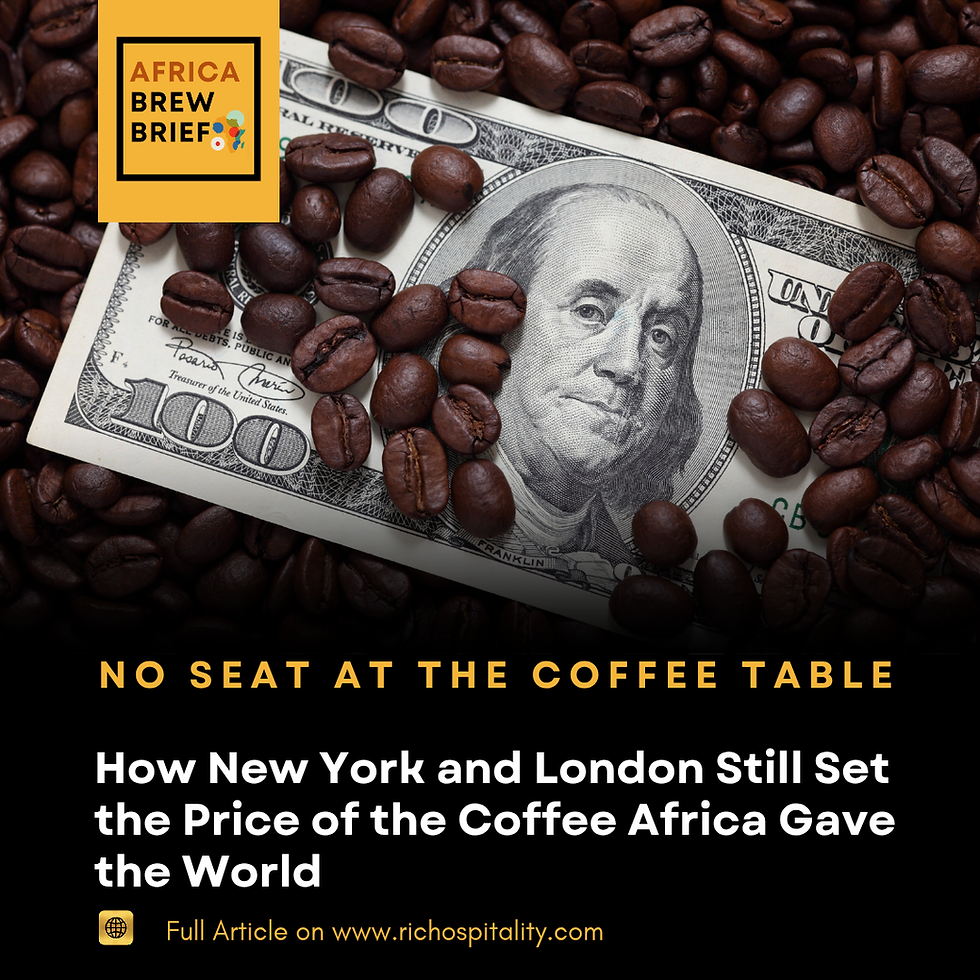
Two exchanges. Zero African chairs. A $50 billion import bill for the continent that invented the crop.*
---
There is a room — two rooms, technically, seven time zones apart — where the price of coffee gets decided every trading day. One sits in lower Manhattan, inside the Intercontinental Exchange. The other sits in London, the descendant of a market born in 17th-century coffee houses that would later spawn the London Stock Exchange itself. Between them, these two rooms set the value of a crop grown by roughly 25 million farmers across more than 50 countries.
Coffee was discovered in Ethiopia. It has never once been priced there.
That is not a poetic flourish. It is the operating structure of a $200 billion global industry, and it is worth sitting with, because it explains almost everything else that follows: why Burundi can derive nearly 80% of its export earnings from a crop whose price it does not set; why Uganda and Ethiopia can each depend on coffee for more than half their foreign exchange while having no formal seat in the exchange that prices it; and why a continent that produces some of the finest, rarest, most storied coffee on earth still runs a coffee trade deficit — exporting roughly $3 billion worth of green beans while importing $50 billion in finished coffee products. Africa sells the seed and buys back the story.
## The Room Was Built for Someone Else's Argument
Coffee futures have traded in New York since 1882. The specific benchmark the world now calls the "C" contract — the reference price for Arabica everywhere on earth — is younger than that, and its origin is almost comically parochial: it was created in 1969 by Central American producers who wanted their coffee priced separately from Brazil's. The "C" stood for "Centrals." It was never designed with East Africa, or West Africa, or the Great Lakes region in mind. It was a Latin American pricing quarrel that grew into a planetary benchmark by historical accident and market inertia.
London's Robusta contract has similar bones — a financial center's mechanism, inherited rather than designed, that happened to become the reference point for Vietnam, Indonesia, Brazil's Conilon, and West and Central African Robusta.
For nearly three decades, a counterweight existed. The International Coffee Agreement, running from 1962 to 1989, used export quotas to keep prices inside a managed band — when the price fell, quotas tightened; when it rose, they loosened. It was imperfect, but it worked, and it gave producing nations, African ones included, actual leverage in a negotiating room. Then in July 1989, talks to renew the quota system collapsed over a dispute about consumer countries' shifting taste for milder coffee. The agreement's economic clauses were suspended. Producing countries lost, almost overnight, whatever seat they had held. The five-year average price fell from $1.34 a pound to 77 cents. That single collapse is the hinge point of modern coffee history — the moment pricing power moved permanently off the farm and onto the trading floor.
## Who Is Actually in the Room
Strip away the mythology of "the market" and four tiers remain, and Africa is structurally absent from the two that matter most.
The exchanges. ICE Futures U.S. and ICE Futures Europe set the rules: contract specifications, delivery grades, warehouse locations, margin requirements. They don't originate coffee. They originate the *rules of the game* — and those rules currently price Rwandan and Burundian coffee at a discount to par, while Colombian and Kenyan coffee sits at a premium, based on grading conventions decided without a single African vote on the exchange's rule-making body.
The merchant houses. This is where the real gravity sits. Neumann Kaffee Gruppe and Volcafe alone move roughly a quarter of the world's coffee trade between them. Neumann controls close to 10% of global demand through fifty subsidiaries across 27 countries. Add ECOM, Louis Dreyfus, Olam, and Sucafina, and a handful of Hamburg-, Geneva-, and Rotterdam-headquartered firms determine the *actual* price a farmer sees — the differential above or below the exchange number — for the majority of the world's coffee-growing population. None of them are African-owned.
The roasters. JDE Peet's, Nestlé, Starbucks, Lavazza, Illy. They sit downstream, largely insulated. When green coffee prices crash, retail shelf prices barely move. When green prices spike, roasters raise prices and protect margin. The volatility is engineered to land upstream — at origin.
The funds. Commodity index funds, CTAs, hedge funds — capital with no interest in a harvest, only in a curve. They add the liquidity that makes the exchange function, and they add volatility that has nothing to do with rainfall in Kigali or frost in Minas Gerais.
Consolidation is accelerating the exclusion. A small cluster of trading giants — ADM, Bunge, Cargill, COFCO, Louis Dreyfus — now holds near-monopoly weight across agricultural commodities broadly, coffee included. Coffee-specific traders have gone under in the last two years. Every bankruptcy and every acquisition concentrates pricing power further into fewer, further-from-origin hands.
## The Ethiopia Paradox
If you want the single most damning data point in this entire system, it is this: Ethiopian exporters are prohibited by their own domestic monetary rules from hedging on the New York futures market. Coffee's birthplace cannot participate in the mechanism that prices its birthright. Ethiopian coffee is instead sold on outright price offers — meaning the New York benchmark, the supposed "world price," has only glancing relevance to the price discovery of the coffee that started the entire industry.
Layer onto that the fact that much of Ethiopia's finest specialty coffee sits above the quality bands the New York exchange even recognizes for delivery, and you arrive at an uncomfortable truth: the benchmark systematically under-prices the coffee it was never built to understand.
## A Century of Games Played With Someone Else's Harvest
This is not a market that has occasionally wobbled. It is a market with a documented, repeating history of manipulation. In the 1970s, a small group of speculators nearly cornered the New York Coffee & Sugar Exchange after anticipating a Brazilian government price move, sending prices from 58 cents to 73 cents a pound in barely a month — control of U.S. prices briefly fell into the hands of five big roasters reacting to the squeeze. In 1979, the CFTC charged a Central American coffee firm and a Cayman Islands entity with executing a "classic long squeeze": they took delivery of 18 million pounds of coffee in New York and shipped it to Brazil — a country that grows more coffee than it could ever need to import — purely to manufacture an artificial shortage and move the tape. Regulators called it manipulation. Farmers in three continents simply called it Tuesday's price.
None of these episodes happened near a coffee tree. All of them moved the income of people who had never heard of the exchange doing it to them.
## What Fair Would Actually Require
Certification schemes have tried to patch the wound without touching the structure. Fairtrade raised its coffee minimum price by 19–29% in 2023 after farmers in its own certified network were leaving the scheme because the floor didn't cover their production costs — a floor that had been marketed as the ethical alternative to the market. If the ethical benchmark needed a near-30% correction just to approach reality, the underlying benchmark it was hedging against was never close to fair in the first place.
Real reform looks like four things, and none of them are radical:
- **African-anchored pricing infrastructure** — not just export volume targets, but liquid, hedgeable exchange mechanisms at origin, so a Rwandan or Ethiopian exporter can manage price risk the way a New York trading desk can.
- **A seat at the table while the contract itself is being rebuilt.** ICE is phasing out the traditional cents-per-pound "C" contract by 2028 in favor of metric-ton pricing — the first rule rewrite of this benchmark in over fifty years. Whoever shapes the new grading and delivery rules resets the differential architecture for the next half-century. That should not happen with African producing nations reading about it after the fact.
- **Value retained at origin** — roasting, milling, and branding capacity on the continent, so the $3 billion export figure and the $50 billion import figure stop pointing in opposite directions.
- **Living-income pricing, indexed and reviewed**, not static certification floors that quietly fall behind the real cost of growing the crop.
---
Coffee's price has never been decided by the people who grow it. It has been decided in two rooms, on two continents, neither of which has ever produced a single bean — and the invoice for that arrangement has been paid, harvest after harvest, by the origin that gave the world its most consumed drink and got, in return, no chair in the room where its worth is argued over.
**A market that prices a crop without the people who grow it in the room is not a market. It is an inheritance nobody signed for.**
RIC Brands exists to put African agribusiness on the other side of that table — as trader, brand-builder, and investment facilitator, not a permanent price-taker.
#CoffeeIndustry #AfricaTrade #GrowAfricaBrandAfricaTradeAfrica #CommodityMarkets #OriginCoffee #AfricaBrewBrief #ValueAddedTrade #FoodSovereignty
---
Africa Brew Brief | RIC Brands — RIC Brands' intelligence platform tracking African agribusiness, commodity trade, and origin stories — reporting the ground truth that shapes better decisions for African agriculture, trade, and investment. Published for buyers, investors, policymakers, and the people building Africa's food future. Follow the brief: https://share.google/vnz8ZqMf6ujiKPr4j | wilbert@ricbrands.com



Comments