
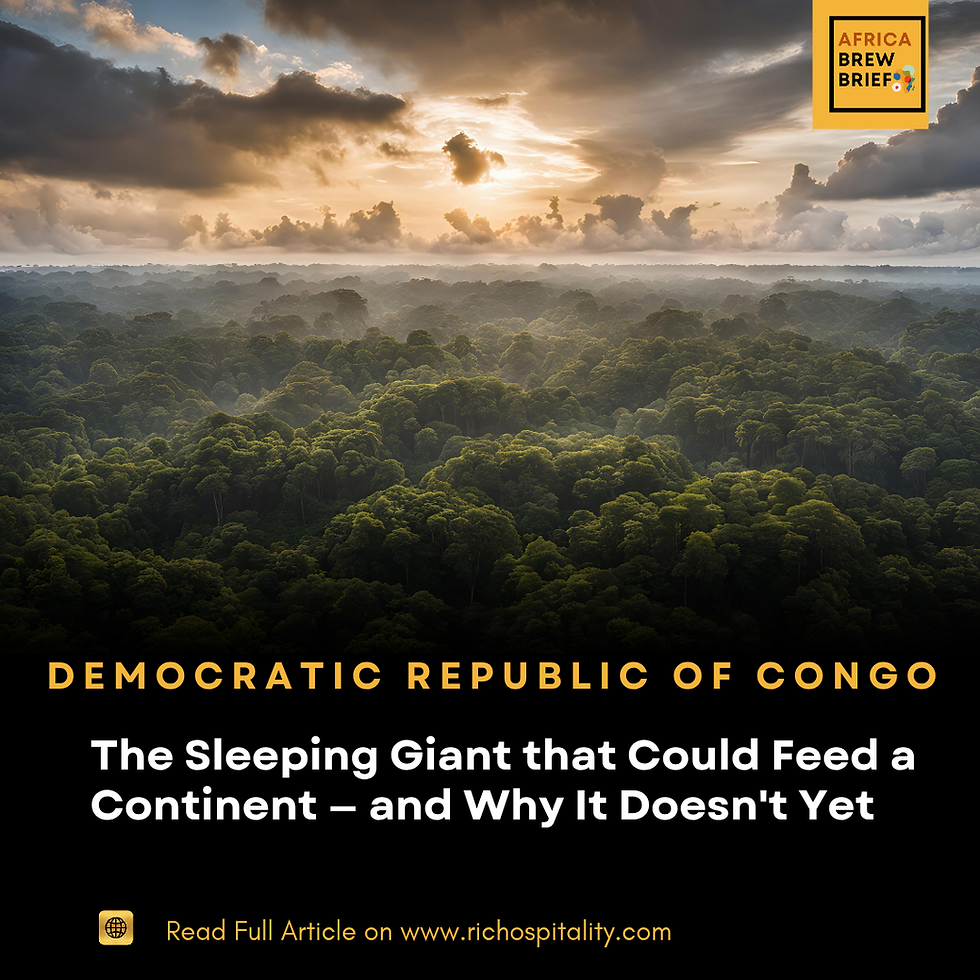
Democratic Republic of Congo : The Sleeping Giant that Could Feed a Continent — and Why It Doesn't Yet
- Wilbert Frank Chaniwa
- 3 hours ago
- 6 min read

Africa Brew Brief — Investigative Feature
There is a peculiar cruelty to the Congolese food economy. A country with more farmable land than any other in Africa spends billions of dollars a year bringing in food it could, in theory, grow better and closer to home. This is the paradox at the heart of the Democratic Republic of Congo's agricultural story: staggering natural endowment, chronic underperformance, and — finally, after decades of false starts — the outline of a real pivot.
## The Resource Base: An Almost Unfair Advantage
Start with the numbers, because they are genuinely startling. DRC holds roughly 80 million hectares of arable land, of which barely 10% is farmed, alongside 4 million hectares of irrigable land, of which only a fraction is exploited. The country's position straddling the equator gives it climate diversity favourable to year-round farming, and it holds a significant share of the world's usable fresh water.
The main cash crops are coffee, palm oil, rubber, cotton, sugar, tea, and cocoa, alongside food staples like cassava, plantains, maize, groundnuts, and rice. Its grasslands and savannahs could theoretically support tens of millions of head of cattle, while its tropical forests cover roughly half of national territory — a major biodiversity reserve. By some estimates, DRC's agricultural potential could feed close to two billion people.
And yet agriculture contributes less than a fifth of GDP, even though the large majority of the population relies on it for their livelihoods. Productivity has never fully recovered from the conflicts of the 1990s onward. This is not a story of absent resources. It is a story of a resource base that has outrun the institutions built to use it.
## The Import Bill: The Cost of Underdevelopment
This is where the paradox turns into hard currency. DRC's imports of agro-food products reached roughly $3 billion in recent years — a figure equivalent to nearly a fifth of the entire central government budget. Total agricultural and related imports have surpassed $1.9 billion annually, while exports remain well below that, even as exports have recently hit record highs.
Europe is a dominant supplier, with wheat and poultry the two largest single export lines into the country. Zambia is the second-largest supplier, largely on the back of regional trade. Older ministry estimates have put the annual food import bill even higher — the range varies by methodology and year, but the direction is consistent: DRC is a heavily import-dependent food market sitting on the continent's largest reserve of unused farmland.
For an agribusiness reader, that gap is the opportunity. Every bag of imported maize flour, every carton of foreign poultry, is import substitution waiting for a domestic supply chain.
## Current Major Projects: Learning From a Painful First Attempt
No honest account of DRC agriculture can skip Bukanga Lonzo — because every serious investor entering the market today is, whether they know it or not, operating in its shadow.
**Bukanga Lonzo (2014–2017): the cautionary tale.** Set up in 2014 through a public-private partnership between the DRC government and a South African commodities firm, this 80,000-hectare park was meant to anchor maize and other commodity production. The state spent close to $100 million of public money before the project collapsed in 2017, with each side blaming the other for cost overruns and unreliable payment. Independent investigations went further, exposing land rights violations, pollution, misspent funds, and corruption allegations. Some defenders pushed back on the "failure" framing, arguing the park should be understood as long-horizon infrastructure for a future agro-industrial city rather than a quick-turnaround farm — but even that generous reading concedes the execution was badly mismanaged. Bukanga Lonzo was meant to be the first of 22 planned agro-industrial parks nationwide; more than a decade later, it remains essentially the only one that reached construction.
**Mbanza-Ngungu (2026–): the second attempt, done differently.** This is the project worth watching now. DRC's Agriculture Ministry signed a public-private partnership with a Swiss firm in late 2025 for a $1 billion agro-industrial park in Kongo Central province, covering 105,000 hectares — including 85,000 hectares of farmland for cassava, maize, wheat, rice, and sugarcane. Construction is expected to break ground in mid-2026 over a four-year build, with authorities targeting around 700,000 tonnes of processed foods annually, including wheat flour, sugar, maize flour, milled rice, and cassava flour. The emphasis on processing capacity, not just planting, is a meaningful design shift from the Bukanga Lonzo model.
**Coffee and cocoa — the quiet success story.** Unlike the state-led megaproject model, the coffee-cocoa revival in eastern DRC has been driven by donor-blended finance and private buyers. North and South Kivu produce excellent coffee and cocoa thanks to strong climatic conditions, building on a colonial-era production history that collapsed under Mobutu — and the last decade has seen donors and private-sector partners, including major retail buyers, rebuild the value chain from the ground up. The results are now showing in the trade data: Congolese agricultural exports generated over $500 million in revenue in the most recent reporting year — roughly four times the prior year's figure. That growth has attracted structured finance: a UK-backed facility of around $25 million, delivered through DRC's largest commercial bank, is now targeting cacao, coffee, rice, cassava, corn, and palm oil exporters, addressing the fact that agricultural lending has historically made up under 1% of total bank lending in the country.
**Palm oil's institutional push.** DRC has joined the Council of Palm Oil Producing Countries, with a leading domestic plantation operator positioned as a key implementation partner. The government is also running national seed-distribution programmes for palm oil, coffee, and cocoa to lift smallholder productivity.
**A national export task force.** Following a technical meeting between the Minister of Foreign Trade and the National Agency for Export Promotion, the government is assembling a "Made in DRC" export task force aimed at getting coffee, cocoa, palm oil, chilli, soy, sesame, rubber, and timber into markets in China, the UK, the UAE, and the EU, with a focus on meeting international certification and traceability standards.
## Trade Geometry: Intra-African and Global
DRC's trade positioning is shifting on two fronts simultaneously.
**Regionally**, the country is stitching itself into every major bloc at once. DRC formally joined the East African Community in 2022, becoming its seventh member state. More recently, SADC concluded a week of high-level engagements in Kinshasa to support DRC's accession to the SADC Free Trade Area, focused on aligning the country with SADC's trade, trade-in-services, and transport protocols. Combined with existing COMESA membership, DRC is on track to be one of the only countries active across all three legs of the COMESA-EAC-SADC Tripartite arrangement — the direct building block for AfCFTA. Infrastructure is following: a major partial credit guarantee from the African Development Bank is helping unlock several billion dollars for a standard-gauge rail corridor linking Tanzania, Burundi, and DRC — a corridor that matters enormously for moving grain and cash crops to port.
**Globally**, the direction of travel is toward diversifying export destinations beyond the traditional European buyers, with China, the UAE, and Gulf markets increasingly named alongside the EU and UK in official export strategy documents.
## Key Challenges
Strip away the announcements and a few structural problems recur across every project and every commodity chain:
- **Finance starvation.** With agricultural lending at under 1% of total bank credit, most Congolese farmers — including commercial-scale coffee and cocoa growers — cannot access working capital for inputs, let alone expansion.
- **Governance and execution risk.** Bukanga Lonzo is the textbook case: sound land endowment, catastrophic implementation, and a decade lost as a result.
- **Infrastructure bottlenecks.** Roads, rail, and cold chain remain the binding constraint on getting perishable and bulk commodities from farm gate to port or regional market.
- **Security and land tenure.** Eastern DRC's best coffee- and cocoa-growing zones sit closest to conflict-affected areas, and land rights disputes have derailed prior agro-industrial projects.
- **Import dependency built into consumption habits.** Urban Kinshasa and Lubumbashi consumer demand — wheat flour, poultry, processed staples — has been shaped by decades of European and Southern African imports, meaning domestic substitution requires winning back entrenched supply relationships, not just building supply.
## What Agribusinesses Should Take From This
1. **Processing capacity is the differentiator, not land access.** DRC has never lacked land. It has lacked mills, driers, cold storage, and certification infrastructure close to the farm gate. The emphasis on processed output over raw tonnage in the newest projects is the correct lesson learned from Bukanga Lonzo.
2. **Blended and guarantee-backed finance is currently the only finance that works.** The de-risking facility model is likely to be the template other development-finance-backed instruments follow in this market. Any agribusiness building a DRC strategy should be scouting these facilities early rather than seeking conventional commercial credit.
3. **Regional accession creates a first-mover trade window.** A country simultaneously joining EAC, pursuing SADC FTA accession, and sitting inside COMESA is, for a short period, a genuine arbitrage opportunity — tariff and regulatory alignment is being renegotiated in real time, and companies with an early compliance and certification presence will have a structural advantage once the frameworks lock in.
DRC remains, by every metric, the most underexploited agricultural frontier on the continent. The question is no longer whether the potential is real — it demonstrably is. The question is whether the next generation of projects learns the Bukanga Lonzo lesson before the money runs out again.
---
**Africa Brew Brief**
*Investigating the trade, policy, and value chains shaping Africa's agribusiness future. Follow the series for more deep dives at the intersection of African trade sovereignty and global market access.*


Comments