
From New World Weed to African Lifeline: The Astonishing 500-Year Journey of Maize — and Why Africa's Food Future Depends on Escaping It
- Wilbert Frank Chaniwa
- 5 hours ago
- 8 min read

Africa Brew Brief — Investigating the trade, policy, and value chains shaping Africa's agribusiness future*
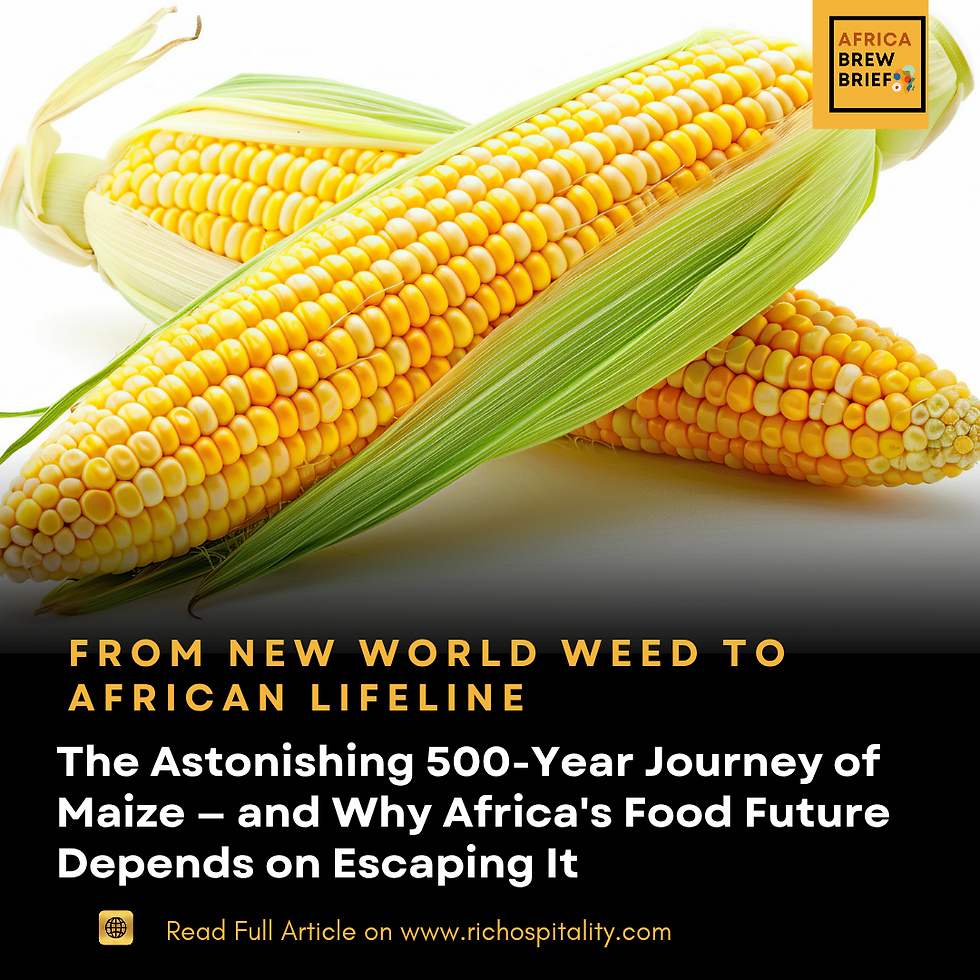
Maize feeds more Africans than any other crop on Earth, yet it is not African at all. It is a New World grass that Portuguese ships carried onto African shores five centuries ago — and today it sits at the center of a $44–58 billion continental market, a nutrition crisis, a soil health emergency, and one of the most consequential agribusiness bets of the next decade.
## What maize actually is, and why it conquered the continent
Maize (*Zea mays*) is a cereal grass domesticated in Mesoamerica thousands of years ago. It arrived in Africa via Portuguese trading networks in the sixteenth century, most likely along the Guinea coast and the Swahili coast simultaneously, carried by traders, missionaries, and the machinery of the slave trade rather than by deliberate agricultural policy. For roughly 300 years it remained a minor crop, grown alongside sorghum, millet, and plantain rather than replacing them.
Its uses are broad: maize is milled into flour for ugali, nshima, sadza, pap, and fufu-style staples; processed into grits, starch, and syrup; fermented into local beers; pressed for cooking oil from the germ; and — increasingly — crushed into feed for the poultry and livestock industries that now consume a growing share of the crop. Roughly 70% of maize grain is used directly for human consumption in sub-Saharan Africa, with maize supplying about 38% of food calories to consumers across the continent — a dependency unmatched by any other crop.
## The colonial engine: how a "swine feed" became a forced staple
European accounts as late as the 1590s dismissed maize as unfit for human consumption — one contemporary writer described it as nourishing little, being hard to digest, and more suitable for swine than men. Maize's transformation from marginal crop to dominant staple was not organic; it was engineered by colonial administration.
In East Africa, the pivot came in the early twentieth century. During the colonial era maize spread rapidly in Kenya and Tanzania as a staple food and rations for workers hired by European planters and mining companies. In Kenya specifically, maize cultivation was substantially driven by British colonialists, who grew it widely for export to feed World War I soldiers and to provide farm labourers with food rations, or "poshos" — a system that replaced diverse traditional diets with the plain, standardized white ugali that still dominates Kenyan tables. In Southern Africa, after epidemics affecting staples like millet in the early 1900s, colonial governments introduced and promoted white maize as both a subsistence and cash crop because it was easy to grow and process — and maize developed in parallel as a commodity crop serving white settler farmers and a subsistence "escape crop" for marginalised Black smallholders, a dual-track legacy South Africa's agriculture still carries.
The driving force, in short, was administrative convenience: maize stores well, matures faster than sorghum or millet, mills into a uniform ration, and could be taxed, traded, and controlled by colonial marketing boards in ways that scattered indigenous grain systems could not. It was a crop built for control, not for African soils or African nutrition.
## The agriculture it built — and the agriculture it displaced
Maize's spread reshaped African farming systems on a scale few crops have matched. By the close of the nineteenth century maize was found virtually everywhere in sub-Saharan Africa with the exception of Uganda, but its status as the *core* dietary staple across eastern and central Africa came later, enabled specifically by the rise of large-scale commercial farming under colonial and post-colonial agricultural policy.
The cost of that dominance is now well documented. Africa's traditional staples — sorghum, millet, and hardy indigenous grains — were pushed to the margins of both the field and the plate, alongside their agronomic advantages: deeper rooting, better drought tolerance, and more balanced amino acid profiles. Because maize-focused diets and farming often produce yields more easily destroyed by adverse climate conditions, and because maize falls short of the nutritional requirements once met by millet and sorghum, researchers point to the rise of kwashiorkor cases as Africans shifted from traditional diets to maize and rice through the 1900s.
## The seeds: hybrids, drought-tolerance, GMOs, and the nutrition fix
Three waves of seed innovation now sit on top of the colonial maize base:
**Drought-tolerant conventional breeding.** CIMMYT and IITA's Drought Tolerant Maize for Africa (DTMA) and Stress Tolerant Maize for Africa (STMA) programs, backed by the Gates Foundation, have released more than 200 distinct drought-tolerant lines across 13 sub-Saharan countries, delivered to three million farmers across Africa. Field evidence shows these varieties yield 20–35% more than non-tolerant types under drought stress, with Zimbabwean trials showing average gains of 0.6 tonnes per hectare and roughly $240 per hectare in additional income. Critically, these are bred conventionally — the drought tolerance in CIMMYT, IITA, and national-institute varieties is developed through conventional breeding methods, so they are not GMOs.
**Genetically modified stacked-trait maize.** The TELA maize project (formerly Water Efficient Maize for Africa/WEMA) is a public-private partnership pairing drought tolerance with insect resistance. Nigeria approved TELA maize for open cultivation in 2021 — the first stacked-trait GM seed released in the country — engineered for drought tolerance and resistance to stem borer and fall armyworm. The technology piloted first in South Africa, Uganda, Kenya, Tanzania, and Mozambique, though it remains politically contested, with critics noting the commercial interests of the multinational agribusiness partners behind it.
**Biofortification for nutrition.** Because white maize-based diets fail to supply adequate vitamin A, zinc, and iron, adversely affecting health across the lifespan, HarvestPlus and partners launched provitamin A maize biofortification roughly fifteen years ago. To date, at least 70 elite provitamin-A varieties have been developed to curb vitamin A deficiency in sub-Saharan Africa, which affects more than 250 million children in developing countries. Recent breeding gains have been substantial: a 12-year breeding program achieved annual genetic gains of 2.05% in provitamin A and 1.88% in grain yield simultaneously, identifying hybrids that combine 54–95% more provitamin A with 10–30% higher yields than the best commercial checks — directly rebutting the old assumption that nutrition and yield trade off against each other. Adoption remains slow, however, partly because the orange color of biofortified maize has triggered negative consumer perceptions in markets conditioned for generations to associate white maize with quality.
## The soil the seed revolution hasn't fixed
Seed innovation has outpaced soil stewardship. Continuous maize monocropping — a direct legacy of the colonial cash-crop model — has driven nitrogen and organic matter depletion across much of the smallholder maize belt, a problem compounded by fertilizer costs smallholders often cannot sustain. Agronomists increasingly note that drought-tolerant seed alone cannot substitute for integrated soil fertility management, crop rotation with legumes, and organic matter replenishment. Diversifying land back toward legumes and indigenous grains is not nostalgia; it's the agronomic corrective the maize monoculture demands.
## Where Africa's maize actually goes
Trade flows reveal a continent still largely feeding itself, with a thin but growing export layer:
- **South Africa**, the continent's dominant exporter, is targeting roughly 3 million tonnes of maize exports for the 2026/2027 season, a 50% rise from the 2 million tonnes shipped the prior season, off a harvest estimated at 16.8 million tonnes against domestic use of about 12 million tonnes.
- **Regional buyers dominate white maize (human consumption).** Zimbabwe alone accounted for about 39% of South Africa's 2025/2026 export volume, nearly 780,000 tonnes, with Botswana, Eswatini, Lesotho, Mozambique, and Namibia rounding out the regional buyer list.
- **Far East buyers dominate yellow maize (animal feed).** South Korea, Vietnam, Japan, and Taiwan are the key Far East destinations, buying primarily yellow maize for animal feed, while white maize exports go almost entirely to African markets. Sri Lanka and Venezuela have also emerged as buyers.
- **Nigeria and Kenya remain largely domestic-consumption markets**, with Nigeria's poultry industry now a major internal demand driver even as the country wrestles with import dependence in deficit years.
## Top African producers
Based on the most recent marketing-year data:
1. **South Africa** — 13.4 million tonnes in 2024, with Agbiz estimating the 2025/2026 crop at 16.8 million tonnes
2. **Nigeria** — 11.05 million tonnes in 2024, projected to reach approximately 16.3 million tonnes in 2025, despite low yields of 1.9–2.2 tonnes per hectare and post-harvest losses exceeding 20%
3. **Ethiopia** — 10.2 million tonnes on 2.55 million hectares, the fastest-growing major producer
4. **Egypt** — 7.2 million tonnes
5. **Tanzania** — 7 million tonnes, up from 5.9 million the prior season
6. **Uganda** — 4.95 million tonnes
Continent-wide, Africa produced nearly 95 million metric tonnes in 2023/2024, with USDA forecasting a decline to around 91 million tonnes in 2024/2025.
## Market size
The Africa maize market is valued at USD 44.5 billion in 2025 and is forecast to reach USD 58.6 billion by 2030, growing at a CAGR of 5.66%, driven by population growth, urbanization, and expanding industrial (feed and processing) applications. Nigeria leads with 15% of Africa's maize market share, while Ethiopia is the fastest-growing market at a 6.8% CAGR.
## The challenges and gaps
- **Storage and logistics losses are staggering.** Storage and logistics inefficiencies waste an estimated 14–18% of harvested maize across Africa every year.
- **Fall armyworm is a multi-billion-dollar drain.** Since its 2016 arrival, fall armyworm has spread across sub-Saharan Africa, severely damaging maize, sorghum, and rice, with continent-wide annual losses estimated at US$9.4 billion, and country-level yield losses ranging between 8.3 and 20.6 million tonnes across just twelve African countries, valued at US$2.48–6.19 billion annually.
- **Aflatoxin contamination threatens both health and trade.** Roughly 25% of crops in tropical and subtropical regions are contaminated with aflatoxin, with maize and groundnuts often exceeding global safety limits by a hundredfold, a risk worsened by high temperatures, drought stress, insect damage, and poor post-harvest handling — and one that can shut African maize out of premium export markets entirely.
- **Climate volatility is structural, not cyclical.** South Africa's own 2023/2024 crop dropped 20% year-on-year due to a severe late-2023 drought, illustrating how exposed even the continent's most mechanized maize economy remains to rainfall variability.
- **Nutrition adoption lags behind breeding science.** Despite provitamin A maize matching or beating conventional yields, uptake is constrained by consumer colour bias and limited farmer awareness — a market-education gap, not a science gap.
## What agribusiness should take from this
For operators building trade, cold chain, and knowledge-transfer platforms across Africa, maize's history is a cautionary tale and a live playbook simultaneously. Three lessons stand out:
**First, seed technology without soil and storage investment is a half-solution.** Drought-tolerant and biofortified varieties are proving their agronomic case; the bottleneck is now firmly in infrastructure — drying, storage, aggregation, and cold-adjacent logistics — where 14–18% of harvest value is lost before it ever reaches a market. This is precisely the gap cold chain and post-harvest infrastructure plays, like RACS, are built to close.
**Second, the yellow/white maize trade split is a genuine market-access lesson.** South Africa's experience shows two distinct value chains — white maize for regional human consumption, yellow maize for Far East feed markets — commanding different buyers, different price dynamics, and different quality requirements. Agribusinesses building trade facilitation platforms should treat these as separate product lines with separate market strategies, not a single "maize export" thesis.
**Third, the crop's colonial origin is a call to rebalance, not to abandon it.** Maize is not going anywhere — it feeds too many people, too cheaply, to be displaced overnight. But the food sovereignty case for reintroducing sorghum, millet, and indigenous legumes alongside maize — for soil health, nutrition, and climate resilience — is now backed by hard agronomic and public health evidence, not just cultural sentiment. That reframing, paired with women-led cooperative models and Fairtrade-aligned sourcing, is where the next generation of African agribusiness value creation sits.
---
*Africa Brew Brief: Investigating the trade, policy, and value chains shaping Africa's agribusiness future. Follow the series for more deep dives at the intersection of African trade sovereignty and global market access.*



Comments