
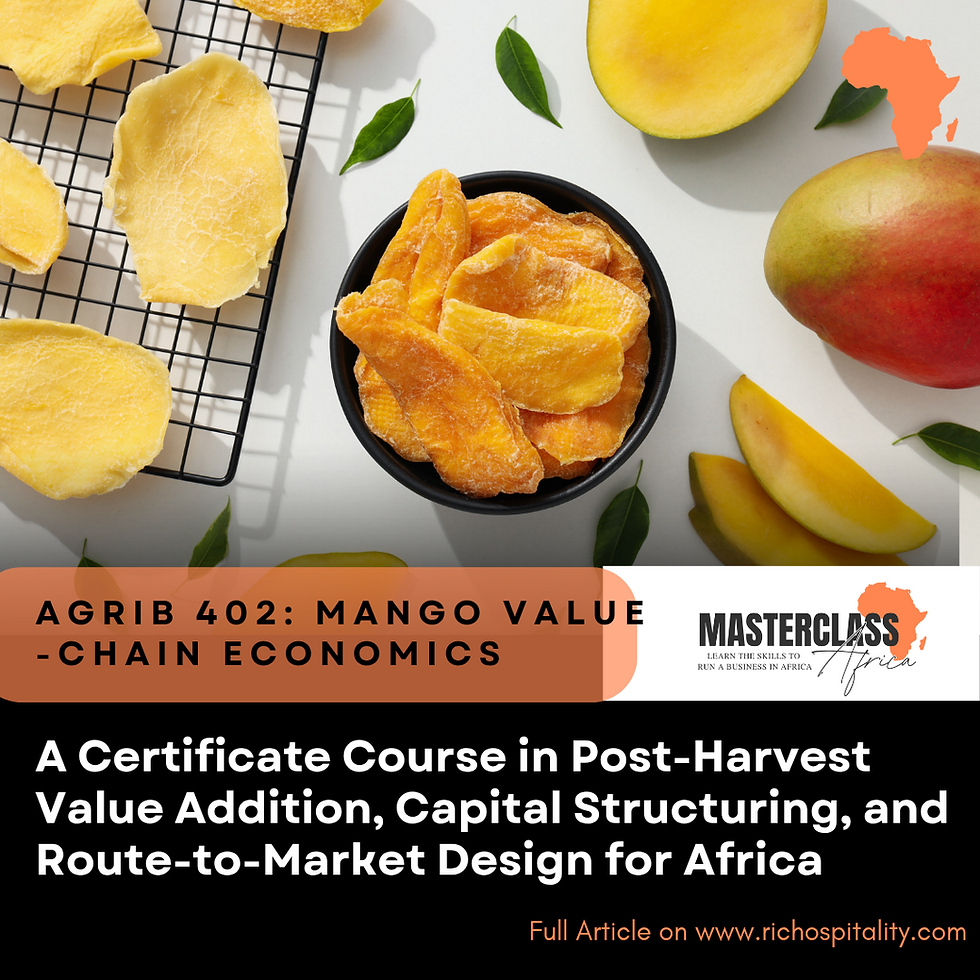
AGRIB 402: Mango Value-Chain Economics — From Orchard Loss to Shelf-Ready CPG Brand A Certificate Course in Post-Harvest Value Addition, Capital Structuring, and Route-to-Market Design for Africa
- Wilbert Frank Chaniwa
- 2 days ago
- 7 min read

Masterclass Africa Presents
Course Teaser: The Business Case Nobody Told You
Here is the number that should keep every mango farmer's investor up at night: across African value chains, mango post-harvest losses sit in a range as wide as 36 to 60.6 percent, with Ghana-specific studies citing losses between 20 and 50 percent, and a separate study putting Ghanaian mango losses as high as 49 percent. In Kenya, Africa's fourth-largest mango producer at over 700,000 tonnes annually, behind Malawi, Nigeria, and Egypt, smallholders still watch a third of their harvest rot before it reaches a buyer.
This is not a farming problem. It is a processing infrastructure gap — and it is the single largest arbitrage opportunity in African agribusiness today.
Globally, mango production exceeded 61 million metric tons in 2023, with Africa contributing roughly 13 percent of that volume against Asia's 77 percent. Yet the global mango pulp and juice market alone was valued at USD 2.04 billion in 2025, projected to reach USD 3.36 billion by 2034, and the broader global mango market was valued at USD 55.20 billion in 2025, projected to reach USD 68.30 billion by 2030. Africa is growing a disproportionate share of the raw material and capturing a disproportionately small share of the processed-value economy. That gap is where the CPG entrepreneur belongs.
AGRIB 402 is built to close it — module by module, cost line by cost line.
---
### Why This Course Exists
Most agripreneur training stops at the farm gate. It teaches agronomy, irrigation, pest management — all necessary, none sufficient. What it rarely teaches is the harder discipline: how to convert a perishable commodity into a branded, shelf-stable, investable Consumer Packaged Goods (CPG) business before the fruit rots in a basket.
This course sits squarely inside Masterclass Africa's Agripreneur Mastery track and is built on the conviction that Africa does not have a production problem — it has a value-capture problem. Every module below maps to a real cost line, a real market, and a real decision an agripreneur must make in year one.
---
### Module 1: The Loss Problem — Quantifying What You Are Actually Solving
Before capital, before branding, before a single label is printed, you must understand the economics of decay. Post-harvest loss in mango is driven overwhelmingly by three failure points: inadequate cold chain, poor handling infrastructure at aggregation, and slow time-to-market. In Ethiopia, mango post-harvest loss on horticultural state farms has been measured at 26.3 percent, while a wider fruit-loss study put overall losses at 6.5 percent, with mango specifically at 6.4 percent — evidence that loss rates swing enormously depending on handling standard, not climate. One Nigerian producer study found that 85.7 percent of producers experienced post-harvest losses from pest and disease infestation, with an average of 27.5 percent of total harvest lost during peak season, and identified inadequate capital, not inadequate knowledge, as the binding constraint on adoption of post-harvest technology.
The continental pattern is stark: fruits and vegetables carry the highest post-harvest loss of any commodity category, estimated at 20 to 50 percent, and in extreme cases up to 60 percent, before reaching consumers — a loss pattern that also contributes an estimated 8 to 10 percent of global greenhouse gas emissions and deepens food poverty. Across Sub-Saharan Africa generally, roughly 96 percent of underutilized food is lost post-harvest, versus only 4 percent wasted after reaching consumers — meaning the crisis point is upstream, not on the consumer's plate.
**The agripreneur's takeaway:** every percentage point of loss you eliminate through processing is a percentage point of margin you capture that your competitors are still leaving on the orchard floor.
---
### Module 2: CAPEX — What It Actually Costs to Build a Mango CPG Line
This module strips away the vague "get a processing facility" advice and gives you real cost bands by product line.
**Farm-level infrastructure (pre-processing):** For a 10-hectare commercial mango operation, expect total start-up CAPEX of USD 850,000 to 950,000, including land, irrigation, and facility construction — of which specialized processing machinery to move beyond raw fruit sales into dried mango and puree typically requires a dedicated budget of around USD 100,000.
**Dedicated processing plants, by product line:**
- A mango juice processing line (extraction, filtration, pasteurization): USD 200,000 to 500,000, depending on capacity and automation level.
- A mango puree line (concentration plus aseptic packaging): USD 500,000 to 1,000,000 — the higher cost reflects the aseptic packaging step required for export-grade shelf stability.
- Industrial-scale export-certified plants operating at 20,000–50,000 metric tons annual capacity are now the benchmark for competing in premium juice, puree, concentrate, and specialty-ingredient markets across North America, Europe, the Middle East, and Asia-Pacific.
**The strategic insight:** capital allocated to refrigeration and cold storage is your highest-leverage spend. Financial modelling for mango operations consistently recommends leasing rather than purchasing specialized refrigeration to convert fixed CAPEX into flexible OPEX in the early, cash-constrained years — a decision that directly determines whether your business survives its first two harvest cycles.
---
### Module 3: Packaging and Branding — Where CPG Margin Actually Lives
A commodity mango sold at the farm gate earns pennies. A branded, packaged mango product — dried slices, puree sachets, single-origin juice — competes in a market growing at a compound annual rate of roughly 5.7 percent through 2034. The difference between those two outcomes is not the fruit. It is the packaging, the label story, and the export-compliance standard behind it.
This module covers:
- Food-grade, HACCP and ISO-aligned packaging design, and why non-compliant packaging is the single most common reason African CPG exports are rejected at port.
- Aseptic and shelf-stable packaging innovation as the technology unlocking year-round mango product availability rather than seasonal-only sales.
- Brand storytelling for export and diaspora markets — positioning single-origin, Fairtrade-sourced mango CPG against generic bulk pulp suppliers.
---
### Module 4: Distribution, Logistics, and Cold Chain — The Make-or-Break Layer
Every mango CPG business plan collapses or scales on this single variable: can the product move from plant to shelf without a second wave of loss? This is the connective tissue between Africa One Fund's AOne Agrico pillar and RACS — RIC Africa Central Supply — the pan-African cold chain infrastructure designed precisely to solve this bottleneck across production corridors.
The module works through:
- Cold chain corridor design and the real cost of building versus leasing refrigerated logistics.
- Aggregation-point strategy — reducing the transport and marketing-stage losses that studies identify as the dominant loss point for mango specifically, ahead of harvesting-stage losses.
- Export documentation, phytosanitary compliance, and market access into EU, Gulf, and regional African markets.
- Route-to-market sequencing: local retail versus regional trade versus export, and the working-capital implications of each.
---
### Module 5: Market Access and Investment Facilitation
Building your investor-ready case — ticket size, instrument type, and the impact metrics increasingly required by DFIs and impact investors underwriting African agri-CPG deals: Fairtrade sourcing, women-led cooperative inclusion, and smallholder knowledge-transfer outcomes.
---
### Module 6: Live Capstone Cohort Session — Present Your Business Case
Learners present their own mango CPG business case to faculty and peer cohort for structured feedback before graduation.
---
### Online Course Format (Masterclass Africa Standard)
AGRIB 402 follows the same delivery architecture as the wider Masterclass Africa suite — HORECA Mastery and Agripreneur Mastery — built for working agripreneurs, cooperative leaders, and investors who cannot step away from operations for weeks at a time.
**Format:** Blended — self-paced core curriculum plus live cohort sessions
**Duration:** 6 weeks, one module released per week
**Structure per module:**
- Core video lesson (25–35 minutes), delivered by RIC Brands / Masterclass Africa faculty and guest practitioners from across the mango value chain
- Downloadable course manual covering the module's frameworks, cost tables, and worked examples
- A live 90-minute cohort session (weekly, virtual) for Q&A, case review, and peer benchmarking across cohort businesses
- A practical assignment applied to the learner's own business — for example, building your own plant-level CAPEX table in Module 2, or your own loss-audit in Module 1
- A short knowledge-check to unlock the following week's module
**Platform:** Delivered via the Masterclass Africa learning portal, accessible by desktop and mobile, with all manuals and slide decks downloadable for offline reference — built for learners across varying connectivity environments on the continent.
**Cohort model:** Learners are grouped into small cohorts (typically 15–25) by value-chain stage — smallholder producers, aggregators/processors, and investor/DFI participants — so live sessions stay relevant to where each learner actually sits in the chain.
**Faculty and guest practitioners:** Core teaching from RIC Brands / Masterclass Africa faculty, supplemented by guest sessions from operators active in mango processing, cold chain, and export trade — consistent with the practitioner-led model used across the Agripreneur Mastery and HORECA Mastery suites.
**Certification:** Learners who complete all six modules and submit their applied assignments receive a Masterclass Africa Certificate of Completion in Mango Value-Chain Economics, positioned as a credential agripreneurs can present directly to cooperatives, buyers, and capital partners.
**Course materials included:**
- Full course manual (PDF, six modules)
- CAPEX and OPEX modelling templates (Module 2)
- Packaging and compliance checklist (Module 3)
- Cold chain and logistics cost-comparison worksheet (Module 4)
- Investor-readiness template covering impact metrics (Module 5)
**Post-course support:** Graduates are added to the Masterclass Africa alumni network, with continued access to Africa Brew Brief market intelligence and priority consideration for Africa One Fund's AOne Agrico deal pipeline where their business fits the mandate.
---
### Who This Course Is For
Smallholder mango producers ready to move up the value chain. Agripreneurs raising their first CAPEX round for a processing facility. Cooperative leaders building export-grade aggregation models. Investors seeking to underwrite the diligence questions before they write a check.
---
### Register Your Interest
AGRIB 402 is part of the Masterclass Africa Agripreneur Mastery suite, delivered under RIC Brands' Knowledge Transfer pillar — one of the six non-negotiable pillars behind everything we build: food sovereignty and indigenous crop revival, agricultural knowledge transfer, value-added trade and market access, hospitality brand building, Africa investment facilitation, and Grow Africa, Brand Africa, Trade Africa.
To register interest, secure a cohort seat, or discuss a tailored in-country delivery for your cooperative or investment portfolio, reach out directly.
Wilbert Frank Chaniwa
Founder & CEO, RIC Brands


Comments