
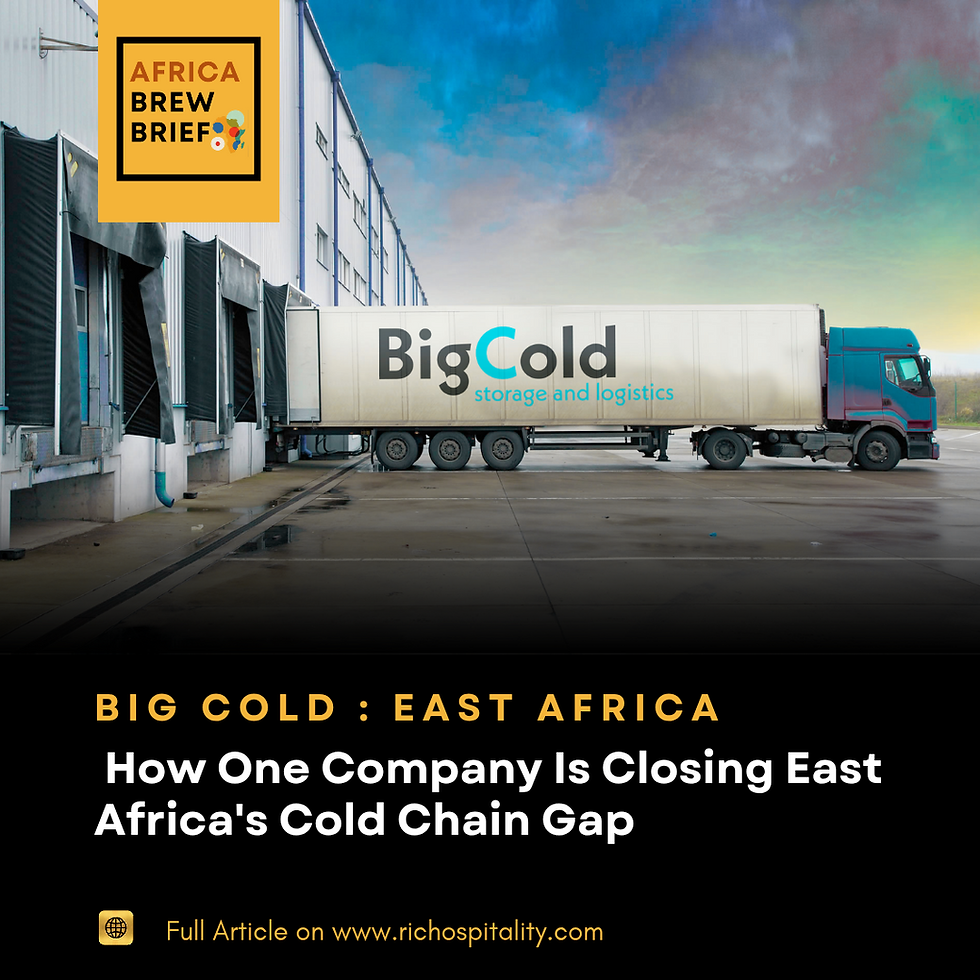
BigCold: How One Company Is Closing East Africa's Cold Chain Gap
- Wilbert Frank Chaniwa
- Jul 2
- 6 min read

Africa loses up to 40% of its perishable food before it ever reaches a plate.** Not because the continent doesn't grow enough. Not because demand isn't there. But because the infrastructure to keep food cold — from farm gate to shelf — simply hasn't existed at scale.
In Kenya alone, a 2025 World Resources Institute Africa study put the annual cost of food loss and waste at KES 72 billion (US$578 million), with 30–40% of everything produced never reaching a consumer. Avocados lose 35% of volume in the domestic market compared to just 15% in export channels. Mangoes lose anywhere from 17% to 56% depending on how they're handled after harvest. Potatoes alone account for KES 12.9 billion (US$104 million) in annual losses.
That gap — between what Africa grows and what Africa actually gets to eat, sell, or export — is the single most expensive infrastructure failure on the continent's food map. It is also exactly the problem BigCold was built to solve.
## The Journey
BigCold is a BlackIvy endeavor. BlackIvy is a US-based holding company anchored in East and West Africa, with offices in Accra, Dar es Salaam, Nairobi, and Washington, D.C., built around the thesis that Sub-Saharan Africa's fastest-growing markets need commercial infrastructure — food, housing, healthcare, warehousing, logistics — built specifically for local conditions rather than adapted from elsewhere.
BigCold launched into that gap from a single hub facility in Nairobi. Within its first year, it was already partnering with some of Kenya's leading food producers and restaurants, running a distribution center that moved goods from dozens of suppliers to more than 60 retail outlets — and it had already become the first food storage and transport company in East Africa to achieve FSSC 22000 Food Safety Management System certification.
That early foundation scaled quickly. Today BigCold's network extends to more than 200 retail outlets, 175 hotels and restaurants, and over 100 institutions across Kenya, Uganda, and Rwanda, operating from bases in Nairobi and Naivasha.
Leading the company is Newton Matope, a supply chain veteran with more than three decades of experience across cold chain, FMCG, ship supply, and catering and life support services — much of it earned in some of the world's most logistically difficult environments. Matope now also serves as Vice Chair of the Global Cold Chain Alliance's Africa Advisory Council, putting BigCold at the center of the conversation shaping how the entire continent thinks about cold chain policy and investment.
## How BigCold Operates
BigCold's model rests on three pillars: certification, technology, and a deliberately diversified client base.
**Certification as competitive moat.** BigCold is the only third-party cold chain facility in East Africa certified to FSSC 22000 and approved by Yum! Brands — the parent company of KFC and Pizza Hut. That single credential does more commercial work than almost any marketing budget could: it signals to every multinational food brand entering East Africa that BigCold's cold chain meets global food safety standards, not just local ones.
**Technology and infrastructure.** Every facility and vehicle runs on real-time temperature monitoring with backup power redundancy, covering frozen, chilled, and ambient-controlled storage. Services extend from bulk storage and blast freezing to dedicated door-to-door delivery, customized delivery runs, and cargo consolidation.
**A client base built on breadth, not dependency.** BigCold serves smallholder farmers, global quick-service restaurant chains, food manufacturers, importers, distributors, and pharmaceutical companies — all off the same infrastructure. That breadth matters commercially: enterprise clients like Yum! Brands help finance the fixed-cost infrastructure that individual smallholder farmers could never afford on their own, while smallholders get access to cold chain standards previously reserved for multinationals.
BigCold has also moved into regional trade directly, exporting products like sausage, frozen fries, and frozen beef to markets including South Sudan, Uganda, and Mauritius, while importing equipment and ingredients from South Africa, China, and Germany.
## Proof in the Partnerships
The clearest evidence of BigCold's impact isn't in its own marketing — it's in what its partners say about it.
When BlackIvy's food production company SimpliFine opened its Kenyan factory, it credited BigCold's cold storage and logistics infrastructure with reducing harvest-to-processing time and increasing the capacity of local farms and their employees. Matope framed the relationship as proof of concept for the whole model: effective production, handling, and delivery of perishables translates directly into better products and better pricing for consumers.
Food Banking Kenya offers an even more instructive case, because it shows BigCold operating beyond a conventional vendor relationship. Matope personally supported the food bank in its early stages — helping source a warehouse, introducing the organization to equipment suppliers and potential partners, and providing free consultancy on warehousing specifications. Co-founder John Gathungu put it simply: BigCold saved the organization from the high cost of acquiring equipment and expanded its network of potential partners, ultimately improving its efficiency.
And when Unga Group — one of Kenya's major milling and manufacturing companies — needed to divest its Ennsvalley Bakery subsidiary, it sold those assets to BigCold. That's a signal worth sitting with: an established manufacturer trusted a cold chain logistics company to absorb and run production assets, not just warehouse the finished product.
## The Honest Challenges
Matope has never dressed up how hard this work is. Speaking on an industry panel, he laid out the structural headwinds plainly: a lack of understanding and acceptance of cold storage as essential infrastructure, unreliable and costly power supply, and a shortage of the technical expertise required to maintain cold storage facilities once they're built. Underneath all of it sits a quieter, more dangerous problem — a widespread cultural acceptance that some percentage of food loss is simply normal.
Fellow panelist Owusu Akoto, founder of Ghana's FreezeLink, offered perhaps the sharpest warning in the room: many parts of Africa have become "a graveyard" for donor-funded cold chain projects. The infrastructure gets built. The skills to run and maintain it in rural Africa don't exist. Within a few years, expensive facilities sit idle.
Cold chain is also only as strong as the infrastructure it depends on — roads and power grids that remain inconsistent across the region. And Kenya's own domestic-versus-export data makes the stakes concrete: the same crop can lose more than double the volume when it isn't backed by proper pre-cooling, reefer transport, and compliant packhouses.
## What the Future Looks Like
The macro trend is unambiguous. Africa's cold chain logistics market was valued at $10.88 billion in 2024 and is projected to reach $14.85 billion by 2029 — an 8.28% compound annual growth rate. Matope himself sees the next wave of growth coming from several directions at once: the safe supply of vaccines and medicines, improving power generation and renewable energy capacity, a rising middle class demanding protein-rich and perishable diets, and strong interest from impact investors, development finance institutions, and international logistics players looking for exposure to the sector.
One structural shift stands out in particular — the rise of "Cooling-as-a-Service" models, which let farmers rent cold storage capacity rather than own it outright, removing the capital barrier that has historically locked smallholders out of cold chain access altogether.
BigCold isn't the only one who sees where this is heading. Kenya's Cold Solutions opened a 15,000-square-metre Grade A cold storage facility at Tatu City in 2023, the first phase of a KES 7.5 billion investment program now running roughly 20,000 pallets of capacity. The competition for East Africa's cold chain future is intensifying — and BigCold's first-mover certification advantage will need to keep earning its place at the top.
## What Other Agripreneurs Can Learn
**Certification is a moat, not a cost.** BigCold's FSSC 22000 and Yum! Brands approvals didn't just open commercial doors — they became the defining story told about the company in every piece of press it has ever received. Certification compounds into reputation in a way marketing spend rarely does.
**Serve smallholders and multinationals off the same infrastructure.** BigCold never chose between impact and commercial viability. It built one infrastructure base and let enterprise clients subsidize the fixed costs that make smallholder access possible.
**Infrastructure without maintenance capability fails.** Akoto's "graveyard" warning is the single most important lesson in this entire story. The differentiator was never the compressor — it's the trained technician and the spare parts supply chain standing behind it.
**Go beyond storage into advisory.** BigCold's relationship with Food Banking Kenya shows the value of building trust and market intelligence for free at the qualifying stage, well before any commercial contract exists. That goodwill converts into partnership later.
**The domestic-export handling gap is the opportunity.** Kenya's own data proves that the same crop loses less than half as much when it moves through export-grade post-harvest handling. Building the infrastructure that brings that same discipline into domestic and regional trade isn't just solving a logistics problem — it's capturing value that currently leaks out of the continent's food economy entirely.
That is, at its core, the same thesis behind RIC Brands' RACS Cold Chain Strategy: that Africa doesn't have a production problem. It has a value-capture problem. And the companies that solve for cold chain first will be the ones that decide who captures that value next.
---
*Grow Africa. Brand Africa. Trade Africa.*
RIC Brands — connecting Africa's agribusiness value chains to global markets.


Comments