
Digital Agriculture, AgriTech & Traceability in Africa
- Wilbert Frank Chaniwa
- May 30
- 8 min read

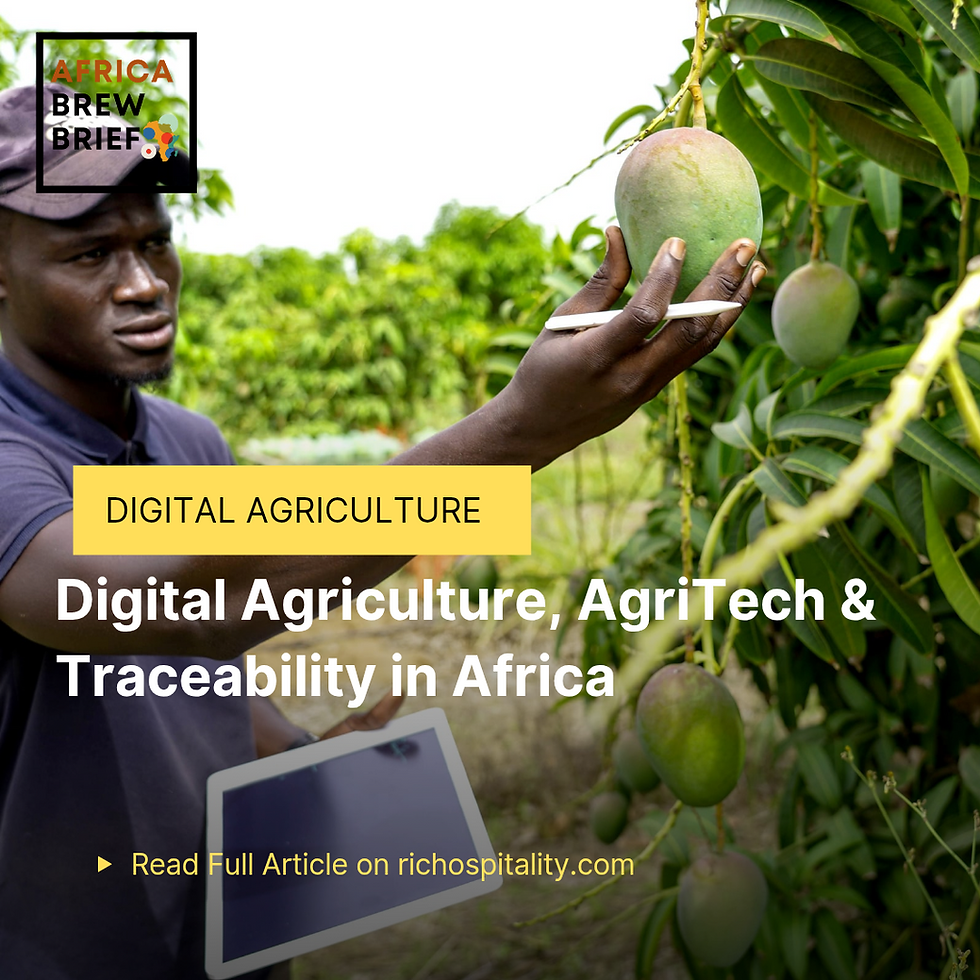
Where the Continent Stands, Who Is Leading, Where the Opportunity Lies, and What Must Be Fixed
*A Strategic Intelligence Report | May 2026*
---
**Introduction: A Quiet Revolution in the Fields**
Africa's agricultural story is being rewritten — not just by rain and soil, but by satellites, algorithms, and mobile phones. Across the continent, a new class of farmer is emerging: one who monitors crop health via smartphone, receives weather alerts by SMS, accesses credit through digital wallets, and sells produce through blockchain-verified platforms directly to global buyers.
This is not a distant vision. It is happening now. Africa's digital agriculture market is currently valued at USD 26 billion (2025) and is forecast to reach USD 44.4 billion by 2030, growing at an 11.3% compound annual growth rate. Venture capital investment in African agritech nearly doubled between 2023 and 2025. The continent's 280 agritech startups have collectively raised over $1.2 billion in funding.
The forces driving this transformation are not merely technological. They are demographic (a youthful, mobile-native population), geopolitical (AfCFTA creating a $3.4 trillion unified market), and regulatory (the EU's Farm to Fork strategy demanding end-to-end traceability from all food exporters). The continent that was once seen as a passive recipient of agricultural aid is rapidly becoming one of the world's most dynamic agritech frontiers.
But progress is uneven. The gap between leading nations and the rest of the continent is wide — and the structural barriers that prevent scaling remain daunting.
---
**Part One: Where Africa Currently Stands**
The Big Picture
Agriculture employs over 60% of Africa's workforce and is the backbone of most national economies. Yet the sector has historically been characterised by low productivity, fragmented supply chains, post-harvest losses estimated at 30–40%, and near-total invisibility to global markets. Smallholder farmers — who produce the majority of Africa's food — have operated without data, without credit, and without consistent market access.
Digital agriculture is changing this equation. AI predicts yields. Blockchain traces exports. Satellite imagery monitors field-level variability. Digital storage facilities manage tonnes of produce. Geospatial mapping identifies locations for processing infrastructure. Mobile money platforms connect farmers to finance without a bank branch in sight.
The most critical development is not any single technology but the emergence of integrated digital ecosystems that link farm-level data to national policy, global supply chains, and investor capital — all through a mobile device.
The Traceability Imperative
Perhaps no single driver is accelerating Africa's agritech adoption more urgently than export traceability requirements. The EU's Farm to Fork Strategy — part of the European Green Deal — now mandates full traceability and sustainability transparency from agricultural production to consumption. Retailers operating in the EU must prove sustainability claims with verifiable, often blockchain-validated data.
For Africa, this is both a threat and an opportunity. Countries and exporters that cannot demonstrate clean, traceable supply chains will be locked out of premium European markets. Those that can — will command higher prices, access broader buyer networks, and attract the institutional investment that follows compliance.
The US FDA's FSMA Rule 204 has similarly catalysed investment in end-to-end traceability platforms for high-risk food categories including leafy greens, nut butters, and seafood. Africa's export sector must adapt or be displaced.
The bottom line: traceability is no longer a "nice to have" feature for African exporters. It is a market access requirement.
Key Technologies in Play
The digital agriculture revolution in Africa is being driven by a convergence of several technologies:
Satellite Imagery & Remote Sensing — Real-time crop monitoring, NDVI vegetation analysis, pest detection, and drought early warning. Platforms like Farmonaut offer accessible apps enabling government agencies and smallholders alike to monitor fields at scale.
Artificial Intelligence & Machine Learning — AI models are being deployed to predict locust swarms, forecast yields, optimise irrigation, and analyse soil health. Microsoft's AI for Earth initiative collaborates with agritech startups to provide precision farming tools using machine learning and satellite imagery.
Blockchain & Distributed Ledgers — The most transformative technology for Africa's export ambitions. Blockchain records farmer identities and crop data history, helps meet EU import rules around zero deforestation and ethical sourcing, and enables smallholders to sell directly to global buyers with verified certifications. Farmers participating in blockchain-verified carbon tracking can earn an extra $300 per year.
IoT & Smart Sensors — Connected devices monitoring soil moisture, temperature, and humidity in real time, feeding data into farm management dashboards.
Mobile & Digital Finance — The most widely adopted layer. From M-Pesa-based credit to blockchain-powered marketplaces, mobile money is the connective tissue of Africa's agritech ecosystem.
---
**Part Two: The Leaders — Countries Setting the Pace**
Kenya — The Silicon Savannah of Agritech
Kenya is the undisputed continental leader in digital agriculture and blockchain-enabled agricultural services — a recognition affirmed by a GSMA Mobile for Development report that named it an early leader among low and middle-income countries globally.
Kenya's dominance is built on several pillars. It raised $95 million in agritech finance in 2024 alone, the highest in Africa. Its startup ecosystem — anchored in Nairobi's "Silicon Savannah" — is supported by enabling policies including the Startup Bill and a national AI strategy. Landmark innovations include Twiga Foods, which partnered with IBM to launch a blockchain-based microfinancing platform; Shamba Records, equipping over 50,000 farmers with AI tools for credit and market access; and Acre Africa, using blockchain to track weather-index insurance for immediate, fair payouts to climate-affected farmers.
Nigeria — The Scale Engine
Nigeria commands Africa's largest startup market, with a $9.8 billion tech ecosystem centred in Lagos. In blockchain specifically, Nigeria leads the continent with 33% of all blockchain deal count in Africa. Key platforms include Farmcrowdy, connecting farmers to investors through a digital platform; Hello Tractor, the "Uber of tractors" connecting tractor owners and farmers through mobile technology; and Cellulant's Agrikore blockchain marketplace, reshaping how Nigerian farmers access premium buyer networks.
South Africa — The Institutional Anchor
South Africa brings institutional depth, advanced infrastructure, and the highest level of private sector agritech investment on the continent. It captures 18% of total African blockchain funding. Over 60% of South African farmers are predicted to adopt digital agritech solutions. The country exported $3.7 billion in agricultural products in Q1 2026 alone — an 11% year-on-year increase — underpinned in part by the credibility that digital traceability brings to its export supply chains.
Rwanda — The Policy Architect
Rwanda punches far above its weight. The government's Smart Agriculture and Mechanisation Strategy links farm-level data to national policy in ways few other African governments have achieved. Innovations include AFRIKABAL, a transparent crop trading network; Smartel Agri Tech, providing solar-powered AI tools that detect crop diseases and send SMS alerts in rural areas with limited internet; and Acre Africa's weather-index insurance blockchain platform.
Ghana — The Export-Compliance Pioneer
Ghana's e-Agriculture platform is a leading example of public–private alignment, linking farm-level data to national policy and improving coordination of inputs, subsidies, and export quotas. Farmerline provides over 1 million smallholder farmers with access to advisory services, market linkages, and financial products via mobile.
Ethiopia — The Coffee Blockchain Pioneer
Ethiopia has pioneered one of the most compelling agritech traceability cases on the continent: coffee farmers using blockchain to sell directly to Starbucks and global specialty buyers. This bypasses the traditional multi-layer commodity chain that historically extracted value from Ethiopian farmers, replacing it with transparent, direct, certifiable trade relationships.
---
**Part Three: Countries With Massive Untapped Potential**
Tanzania — The Agricultural Sleeping Giant
Tanzania is one of Africa's most agriculturally endowed nations — fertile land, diverse climates, and significant smallholder populations growing coffee, tea, cashew, sesame, and horticulture. Yet its agritech ecosystem remains severely underdeveloped relative to its agricultural base. With the right investment in connectivity and export traceability infrastructure, Tanzania could rapidly become East Africa's second agritech hub.
Senegal — West Africa's Emerging Digital Farm
Senegal's TOLBI platform — combining AI and satellite imagery for sustainable farming and crop yield forecasting — signals what is possible. ENDAM AGRI bridges the gap between farmers and essential support systems while deploying trained rural youth agents for on-the-ground implementation. With strong tech talent, a functional port at Dakar, and significant horticultural export potential, Senegal is positioning as West Africa's agritech challenger.
Zambia & Zimbabwe — The Grain Belt Digital Opportunity
Both countries sit at the heart of Southern Africa's grain production belt. Both have university-level agritech innovation pipelines but limited access to continental platforms, funding, and market connectivity. The combination of underutilised arable land, existing farming knowledge, and improving mobile penetration makes both countries high-potential candidates for the next wave of agritech investment.
DRC — The Continent's Greatest Agricultural Frontier
The Democratic Republic of Congo holds 80 million hectares of arable land — more than any other African nation — yet remains among the most agriculturally underdeveloped. Political instability and infrastructure deficits have historically suppressed investment. But the DRC's sheer scale means that even partial digitisation of its agricultural sector could transform regional food security and represents the continent's greatest long-term agritech frontier.
Mozambique — The Indian Ocean Export Corridor
Mozambique's proximity to global shipping routes, combined with agricultural diversity across sesame, cashew, citrus, and aquaculture, makes it an underappreciated export story. Agritech penetration remains low, but platforms from Kenya and South Africa are beginning to extend southward.
---
**Part Four: The Gaps That Must Be Filled**
1. Rural Connectivity Infrastructure
Rural broadband access remains below 35% in many African regions. Cutting-edge AI and blockchain platforms cannot reach the farmers who need them most. The solution requires both government investment in rural connectivity and the development of offline-first, SMS-compatible platforms that function without smartphones or reliable data connections. Rwanda's Smartel model — delivering insights via SMS and solar-powered devices — points the way.
2. Digital Literacy & Human Capital
Many rural farmers need structured training to derive value from digital tools. Technology alone does not transform agriculture. The most effective models combine digital tools with on-the-ground human agents — trained rural youth who assist with crop monitoring, data collection, and platform adoption. ENDAM's hybrid approach in Senegal is a model worth replicating across the continent.
3. The $200 Billion Funding Gap
Only 4% of investment in Africa — and only 3% of global development funding — goes to the agricultural sector, resulting in an estimated funding gap of $200 billion. This is particularly striking given that investments in agriculture are two to four times more effective at raising incomes than investments in other sectors. Capital allocators must understand that the most successful models are hybrid — combining technological innovation with analog human touchpoints.
4. Post-Harvest Infrastructure & Cold Chain
The highest ROI investments in African agribusiness for 2025–2026 are projected in cold chain, processing, and smart logistics. Without adequate cold storage and temperature-controlled logistics, digital traceability cannot prevent post-harvest losses — which remain the continent's most significant source of food value destruction.
5. Regulatory Harmonisation & Data Governance
Digital agriculture generates vast amounts of farmer data — soil profiles, crop histories, financial behaviour. Without clear data governance frameworks, farmers risk exploitation by platforms that monetise their data without consent or benefit-sharing. Harmonised digital standards across African markets are equally critical for cross-border agritech platforms to scale.
6. Gender & Inclusion Gaps
Gender disparities continue to limit the equitable distribution of digitisation benefits. Women, who constitute the majority of smallholder farmers in Sub-Saharan Africa, disproportionately lack access to smartphones, bank accounts, and digital literacy programs. Agritech solutions designed without gender intentionality will systematically under-serve the majority of Africa's agricultural workforce.
7. Fragmented Supply Chains & Middlemen Dependency
Across many African regions, food still passes through multiple middlemen before reaching consumers — each step extracting value, increasing spoilage risk, and reducing farmer income. The core problem is not technological sophistication but supply chain fragmentation. Solving it requires platforms that are as commercially compelling for logistics providers and traders as they are for farmers and buyers.
---
**Conclusion: The Next Decade Belongs to Those Who Build the Infrastructure Now**
Africa is at a defining inflection point in its agricultural history. The technologies exist. The market demand — from EU regulators, global food brands, and 1.4 billion intra-African consumers — is real and growing. The youthful, mobile-native population provides the human capital for transformation at scale.
What the continent needs now is deliberate, coordinated investment in the foundational infrastructure that allows digital agriculture to reach every farmer, every hectare, and every export container.
The countries that will define Africa's agritech future — Kenya, Nigeria, South Africa, Rwanda, Ghana, and Ethiopia — have demonstrated proof of concept. The question is no longer whether digital agriculture works in Africa. The question is whether the public and private sectors can mobilise the capital, the policy frameworks, and the human capacity to scale what works before the window of competitive advantage closes.
For agribusinesses, exporters, and investors: the playbook is being written right now, in the fields of East and West Africa, on mobile phones, and in the ledgers of blockchain networks. The time to position is not tomorrow. It is today.
---
*Sources: Mordor Intelligence, Brookings Institution, GSMA Mobile for Development, FAO Digital Agriculture Strategy, FurtherAfrica, Farmonaut, Tech in Africa, Apps Africa, AgroCentric, African Agribusiness, Frontiers in Sustainable Food Systems — compiled May 2026.*



Comments