
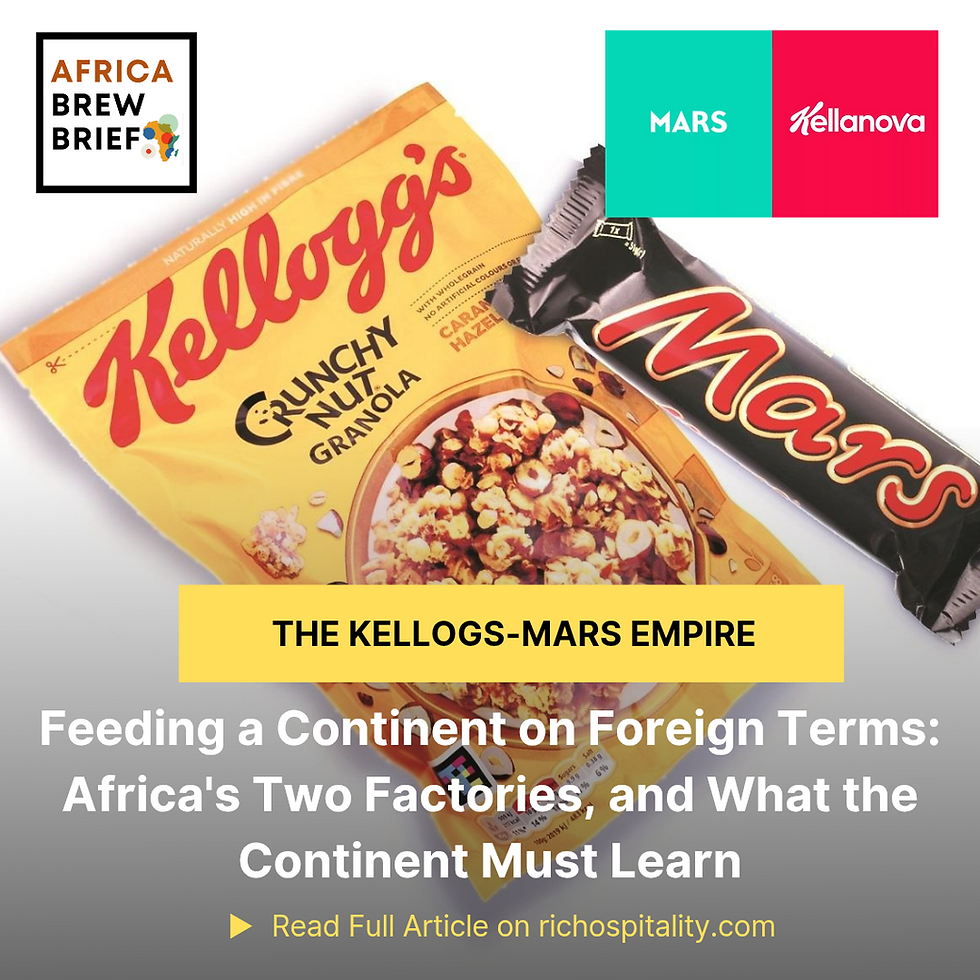
Feeding a Continent on Foreign Terms: The Kellogg-Mars Empire, Africa's Two Factories, and What the Continent Must Learn
- Wilbert Frank Chaniwa
- Jun 19
- 14 min read

An Africa Brew Brief Investigative Report | RIC Brands
---
Prologue: The Day a Cereal Box Changed a Continent's Breakfast
In 1948, a factory opened in Springs, Gauteng — a flat, industrialised town east of Johannesburg — and began producing breakfast cereal for South African households. It was not a South African factory. It was not built with South African capital. The corn that fed it did not begin as a South African idea. The factory belonged to the Kellogg Company of Battle Creek, Michigan — a business founded on the accidental discovery of flaked cereal in 1894 by two brothers who ran a sanitarium.
That Springs plant, now over 75 years old, remains one of only two manufacturing facilities that the Kellogg lineage has ever built on a continent of 54 nations, 1.4 billion people, and some of the most fertile agricultural land on earth.
Seventy-five years later, in December 2025, that modest industrial legacy was absorbed into the largest consumer goods transaction in recent memory: Mars, Incorporated announced the successful completion of its acquisition of Kellanova — the company formerly known as Kellogg — in a deal that brought together Pringles, Cheez-It, Pop-Tarts, Rice Krispies Treats, RXBAR, and Kellogg's international cereal brands under one roof. [Yahoo Finance](https://finance.yahoo.com/news/mars-completes-acquisition-kellanova-131700900.html)
The question this investigation sets out to answer is not simply how big that roof is. It is: who built it, who fills it — and why Africa, which grows the raw materials that fill those boxes, has only two rooms inside.
---
## Part I: The Making of an Empire — From Sanitarium to $36 Billion Snacking Giant
### The Kellogg Origin
Will Keith Kellogg did not set out to build a food empire. He set out to feed patients. In 1894, working at his brother John Harvey Kellogg's Battle Creek Sanitarium in Michigan, he accidentally discovered that wheat dough, when left to sit and then rolled, produced light, flaked grains that patients found digestible and satisfying. The Corn Flake was born — and with it, the industrial breakfast.
In 1914, Kellogg's Corn Flakes were introduced to Canada, and the company would go on to spread globally by opening factories in South Africa, Australia, England, Mexico, Japan, India, and more — eventually reaching consumers in over 180 countries. [Kellogg's](https://www.kelloggs.com/en-za/who-we-are/our-history.html)
By the mid-twentieth century, Kellogg had become the world's dominant cereal company. Its supply chain was a masterclass in vertical integration and brand imperialism: source the grain, process it at scale, brand it aggressively, and distribute it globally. The model was simple, ruthlessly efficient, and deeply profitable.
For decades, Kellogg's international strategy was equally straightforward — build factories in large markets, import product into smaller ones, and use brand strength to hold shelf space regardless of local economic conditions.
### The Restructuring: From Kellogg to Kellanova
By 2022, Kellogg's was feeling the weight of managing disparate categories under one brand. In October 2023, the Kellogg Company changed its name to Kellanova and spun off its North American cereal business into a new entity, WK Kellogg Co. [Wikipedia](https://en.wikipedia.org/wiki/Kellogg's) The logic was structural focus: Kellanova would hold the global snacking portfolio — Pringles, Cheez-It, Pop-Tarts, Eggo — while WK Kellogg Co. retained the cereal heartland of North America.
WK Kellogg Co's products were manufactured through a production platform consisting of six primary facilities. [Publicnow](https://www.publicnow.com/view/7F145BE3C1F8EE5ED3D10ED48345EEA50AC9752D) Kellanova, by contrast, carried the global weight: products manufactured in 20 countries and marketed in more than 180 countries. [q4cdn](https://s203.q4cdn.com/897568180/files/doc_downloads/kd/2025/02/K-2024-Q4-10-K-FINAL.pdf)
The restructuring was not merely cosmetic. It was a strategic repositioning — signalling that the future of Kellogg's DNA lay not in cereal bowls but in snacking, a category that grew through urbanisation, convenience culture, and aspirational consumption in emerging markets. Africa, with its rapidly urbanising population and expanding middle class, was central to that emerging markets thesis.
### The Mars Acquisition: A $35.9 Billion Bet on the Future of Snacking
On August 14, 2024, Mars, Incorporated — the family-owned confectionery giant behind M&M's, Snickers, Dove, and Pedigree — announced it would acquire Kellanova for $83.50 per share in cash, representing a total consideration of $35.9 billion including net leverage. The transaction required 28 separate regulatory clearances globally, with final unconditional approval from the European Commission received on December 8, 2025. [sec](https://www.sec.gov/Archives/edgar/data/0000055067/000119312525310707/d49614dex991.htm) The acquisition completed on December 11, 2025. [sec](https://www.sec.gov/Archives/edgar/data/0000055067/000119312525315130/d90636dex991.htm)
The strategic rationale was explicit. The acquisition represents a significant bet on the global snacking category for the family-owned Mars business, which generates approximately $55 billion in annual revenues across its pet care, snacking, and food divisions. [Food and Drink Digital](https://fooddigital.com/news/what-is-the-significance-of-mars-takeover-of-kellanova)
Following the close of the acquisition, Mars Snacking — powered by a team of more than 50,000 Associates — operates 80 global production facilities and more than 170 retail outlets. The combined business is expected to generate around $36 billion in annual snacking revenues, with a portfolio that includes 9 billion-dollar brands. [sec](https://www.sec.gov/Archives/edgar/data/0000055067/000119312525310707/d49614dex991.htm)
Let that figure settle: 80 production facilities. 9 billion-dollar brands. A $36 billion snacking business. On a continent of 1.4 billion people, with two manufacturing plants — one of which operates through a joint venture with a Singaporean trading group.
---
## Part II: The Manufacturing Empire — 20 Countries, and Africa Gets Two
### The Global Footprint
As of its final 10-K filing before the Mars acquisition, Kellanova manufactured in 20 countries and marketed products in more than 180 countries. [q4cdn](https://s203.q4cdn.com/897568180/files/doc_downloads/kd/2025/02/K-2024-Q4-10-K-FINAL.pdf) That 20-country manufacturing roster covered:
**North America:** Kellanova North America manufacturing operations encompassed facilities in the United States, Canada, and one facility in Mexico. [Kellanova News](https://newsroom.kellanova.com/2024-01-30-Kellanova-set-to-achieve-90-percent-renewable-electricity-across-North-America-in-2024)
**Europe:** Kellanova's largest factory was at Trafford Park in Greater Manchester, United Kingdom — also the location of its UK headquarters. [Wikipedia](https://en.wikipedia.org/wiki/Kellanova) Additional facilities operated across Germany, Belgium, Poland, Spain, Italy, and Ireland.
**Asia-Pacific & Middle East:** Owned facilities in India, South Africa, Thailand, and Malaysia had solar panel installations. [Kellanova News](https://newsroom.kellanova.com/2024-01-30-Kellanova-set-to-achieve-90-percent-renewable-electricity-across-North-America-in-2024) Australia, South Korea, and Egypt held further operations.
**Latin America:** Kellanova's facility in Colombia sources 100% renewable electricity through hydroelectric energy. [Kellanova News](https://newsroom.kellanova.com/2024-01-30-Kellanova-set-to-achieve-90-percent-renewable-electricity-across-North-America-in-2024) Brazil and Argentina carried additional production capacity.
**Africa:** Two plants. South Africa (1948) and Nigeria (2018). Out of 20 countries. Out of 54 African nations.
This is not a footnote. It is the central indictment of how global CPG multinationals have historically approached the African continent — as a consumer market to be served from abroad, not a production ecosystem to be built from within.
### WK Kellogg Co. — The Cereal Spin-Off
Separate from Kellanova's snacking empire, WK Kellogg Co. manufactures its products through six primary facilities [Publicnow](https://www.publicnow.com/view/7F145BE3C1F8EE5ED3D10ED48345EEA50AC9752D) — all in North America. The cereals that millions of African consumers pour into bowls each morning are produced thousands of miles away, shipped across oceans, cleared through ports, and sold at prices that reflect every mile of that journey.
---
## Part III: Africa's Two Factories — History, Function, and Agribusiness Connection
### Plant One: Springs, Gauteng — The Original Foothold (1948)
Kellogg's began selling cereals in South Africa as early as 1923, but the first cereals manufacturing facility in Springs, Gauteng was not opened until 1948. [Kellogg's](https://www.kelloggs.com/en-za/who-we-are/our-history.html) It was the company's earliest factory on the continent, and for 70 years, it remained the only one.
Located east of Johannesburg, the Springs Plant produces and distributes food throughout South Africa. [PR Newswire](https://www.prnewswire.com/news-releases/kelloggs-south-africa-creates-better-days-for-communities-in-need-one-bag-at-a-time-301193592.html) Its product range spans Kellogg's Corn Flakes, All-Bran, Special K, Coco Pops, Rice Krispies, Granola, Pringles Cereal Bars, and — in a globally unprecedented move — in 2018, Kellogg launched a Noodles range in South Africa, a first for Kellogg's globally. [Kellogg's](https://www.kelloggs.com/en-za/who-we-are/our-history.html)
The Springs plant sources corn, wheat, rice, and sugar — the foundational raw materials of its product lines — from South Africa's agricultural sector, primarily through large-scale commodity suppliers and millers. South Africa's maize belt, stretching across the Free State and North West provinces, provides a relatively reliable grain supply chain. However, the plant's connection to smallholder African agriculture has been limited. The inputs are large-scale commercial commodities — not a direct pipeline from smallholder farmers to factory floor.
The South African operation is entirely Kellanova-owned (now Mars-owned), unlike its Nigerian counterpart. Kellogg's South Africa is headquartered in Woodmead, Gauteng, and employs between 100 and 249 people with revenues estimated between $25 million and $50 million. [ZoomInfo](https://www.zoominfo.com/c/kelloggs-south-africa/559692879)
### Plant Two: Lekki Free Trade Zone, Lagos — The Joint Venture (2018)
The Lagos factory tells a fundamentally different story — one of strategic partnership, distribution intelligence, and market entry by proxy.
Kellogg's Tolaram Nigeria Limited, a joint venture between Kellogg's and the Tolaram Group of Singapore, opened a ₦6 billion cereal factory in the Lekki Free Trade Zone, financed by Standard Bank and its local subsidiary Stanbic IBTC Holdings. The two companies had established their joint venture in 2015 to develop snacks and breakfast foods for the West African region. [Nairametrics](https://nairametrics.com/2017/12/04/kelloggs-tolaram-open-n6-billion-factory-in-the-lekki-free-trade-zone/)
The Lekki Free Trade Zone location is deliberate. It places the factory inside a privileged economic corridor — with preferential tax treatment, streamlined import-export processing, and port proximity. The factory was not built primarily to source Nigerian agriculture. It was built to access Nigerian — and West African — consumers efficiently, while minimising the friction of doing business in one of Africa's most complex regulatory environments.
At capacity, the Lagos factory produces in excess of 10,000 metric tonnes of breakfast cereals annually. [Issuu](https://issuu.com/foodworldmedia/docs/fba_issue_46_digital/s/12675667)
The Tolaram connection is the real story here. Multipro is the largest sales and distribution company in West Africa, distributing brands throughout Nigeria, Ghana, and other countries in Africa. Tolaram formed a joint venture with Kellogg's in 2015 to develop snacks and cereals for the African market and noodles for the rest of Africa. [Tolaram](https://www.tolaram.com/our-businesses/) Since then, Kellogg's Noodles have been launched in Egypt and South Africa, selling close to half a billion packets a year across these countries. [Tolaram](https://www.tolaram.com/our-businesses/)
Multipro, established in 1997, has a strong sales and distribution infrastructure in Nigeria — headquartered in Lagos, with access to approximately 1,000 exclusive distributors, 2,600 employees, and 19 warehouses across six locations. [PR Newswire](https://www.prnewswire.com/news-releases/kellogg-company-and-tolaram-announce-new-long-term-partnership-to-significantly-expand-presence-in-africa-300143111.html)
This is the model in its clearest expression: a Western CPG company entering Africa not by building its own distribution network, but by acquiring an existing one — and placing a factory inside a free trade zone to minimise its exposure to the actual African economy it profits from.
In 2018, Kellogg invested a further $420 million to expand its joint venture equity interests in West Africa. [Nairametrics](https://nairametrics.com/2018/05/04/kellogg-invest-420-million-in-tolaram-africa-foods/) The company's own CEO at the time was candid about what drove it: "Africa offers incredible growth opportunities," said Steve Cahillane, Kellogg's Chairman and CEO. "Our experience partnering with Tolaram over the past couple of years have confirmed that we have a strong relationship, attractive brands, local expertise, and a proven business model. Our additional investment is a statement of confidence in this venture." [Nairametrics](https://nairametrics.com/2018/05/04/kellogg-invest-420-million-in-tolaram-africa-foods/)
Confidence in the venture. Not confidence in Africa's agricultural system. Not investment in African smallholder farmers. Confidence in a distribution-led, consumer-facing model that extracts value from African purchasing power while manufacturing as little as possible on African soil.
---
## Part IV: What Africa Grows for the World's Breakfast Table
To understand the Kellogg-Mars relationship with African agribusiness, you must understand the commodity flows — the raw materials that African soil produces, that global multinationals depend on, and that Africa rarely processes into finished goods before export.
Kellogg's obtains its raw materials of wheat, corn, cocoa, rice, and sugar from primary suppliers around the world — these materials underpin more than 40 different breakfast cereals and snacks. [QuickBooks](https://quickbooks.intuit.com/r/supply-chain/supply-chain-management-factory-supermarket-shelves-kelloggs/)
Africa is a primary source for several of these inputs:
**Cocoa:** West Africa — specifically Ghana and Côte d'Ivoire — produces approximately 60-65% of the world's cocoa. Mars is one of the world's largest cocoa buyers. Kellogg's chocolate-coated cereals, Coco Pops among them, depend on West African cocoa. Yet the finished product is manufactured in Europe, North America, or South Africa — not in Ghana or Côte d'Ivoire.
**Palm Oil:** Kellanova committed to purchasing 100% physically certified RSPO palm oil by end of 2025, having achieved 80% by end of 2022. Its work expanded through direct investment with Wild Asia, a Malaysian non-profit that supports smallholder farmers in achieving certification. [Kellanova](https://betterdayspromise.kellanova.com/responsible-sourcing) The palm oil sourcing investment, notably, focuses on Malaysia — not Nigeria or Ghana, which are also significant palm oil producers. Africa grows it; Asia gets the certification infrastructure investment.
**Maize/Corn:** Sub-Saharan Africa produces hundreds of millions of tonnes of maize annually. Kellogg has established Origins™ programs in corn/maize sourcing regions to provide training and technical assistance to improve farm productivity and reduce greenhouse gas emissions. [Mediaroom](https://filecache.mediaroom.com/mr5mr_betterdayspromise/177546/2020ResponsibleSourcingMilestones.pdf) These programmes are concentrated in the United States, Mexico, and Europe — not in Africa's maize heartlands of Kenya, Zambia, Tanzania, or South Africa's Free State.
**Sugar:** East and Southern Africa — Kenya, Ethiopia, Mozambique, Zimbabwe, South Africa — produce substantial sugarcane volumes. These feed into global commodity markets, and from there into processed food supply chains. African cane farmers rarely see the brand value of the products their sugar ends up inside.
The pattern is consistent and damning: Africa provides the raw inputs. The value addition — the processing, the branding, the packaging, the premium pricing — happens elsewhere. A tonne of cocoa beans from Ghana might be worth $2,500 on the commodity market. The same cocoa, transformed into Coco Pops or Kellogg's Chocolate cereal and sold back into Lagos supermarkets, yields multiples of that value — almost none of which remains in West Africa.
---
## Part V: The Import Dependency — Africa Pays a Premium for Its Own Resources
Africa's food imports totalled $97 billion between 2021 and 2023 — an increase of nearly 19% from the 2012-2014 period, according to UNCTAD's State of Commodity Dependence 2025 report. [Ecofin Agency](https://www.ecofinagency.com/news-agriculture/0109-48313-unctad-report-maps-africa-s-97-billion-food-import-dependency-led-by-egypt)
Approximately 282 million people, or 20% of the African population, are undernourished. In 2023, 846.6 million people in Africa were estimated to experience moderate or severe food insecurity. [Afreximbank](https://media.afreximbank.com/afrexim/Food-Imports-and-Food-Security-Addressing-the-Challenges.pdf)
Against this backdrop, Africa continues to import significant volumes of processed CPG products — breakfast cereals, snacks, packaged noodles, biscuits, flavoured dairy — from producers who source their raw materials from African soil, manufacture elsewhere, and sell the finished product back at prices that reflect the full cost of global supply chains.
In Mozambique, consumer packaged goods expenditure, led largely by food, accounts for around 30% of monthly household spending in urban areas. The country's main FMCG brands come from the United States, South Africa, China, India, the UAE, Singapore, and Portugal. [International Trade Administration](https://www.trade.gov/country-commercial-guides/mozambique-fast-moving-consumer-goods) Mozambique itself does not appear on that list.
In Nigeria and Kenya, the FMCG market value declined 4.3% in 2023 compared to 2022, with units seeing a similar 2.1% volume decline — driven by price inflation. Traditional trade still dominates the retail landscape, with a 58.2% contribution in 2023, while Modern Trade contributed 41.8%. [NielsenIQ](https://nielseniq.com/global/en/insights/analysis/2024/nigeria-state-of-the-nation-2023-overview/)
Local brands in Africa and Asia are capturing over 30% of market share in certain FMCG categories [Marketreportsworld](https://www.marketreportsworld.com/market-reports/fmcg-fast-moving-consumer-goods-market-14720327) — a figure that should be read both as a warning to multinationals and as a signal to African entrepreneurs. The window is open. The question is who steps through it.
Kellanova's own AMEA (Asia, Middle East and Africa) segment tells its own story. In the third quarter of 2024, AMEA's reported net sales decreased 10% year-on-year, largely due to adverse foreign currency translation principally related to the Nigerian Naira's devaluation. Yet on an organic basis, net sales increased 22%. [sec](https://www.sec.gov/Archives/edgar/data/0000055067/000162828024044435/exhibit991q3-2024.htm) The volume growth was real. The structural dependency — pricing products in dollars, selling into naira — is the tax Africa pays for not controlling its own manufacturing.
---
## Part VI: The Strategic Architecture — What the Model Actually Is
Strip away the press releases and the sustainability reports, and the Kellogg-Mars model in Africa is a four-layer architecture:
**Layer 1 — Raw Material Extraction:** Source agricultural commodities from African producers at global commodity prices. Do not invest meaningfully in processing those commodities on African soil.
**Layer 2 — Manufacturing Elsewhere:** Process those raw materials into branded, high-margin finished goods in facilities in Europe, North America, and Asia-Pacific. Keep manufacturing in Africa limited to markets large enough to justify factory investment, and in those cases, use free trade zones and joint ventures to minimise risk exposure.
**Layer 3 — Distribution Acquisition:** Rather than build African distribution networks from scratch, acquire or partner with existing local operators — as Kellogg did with Multipro/Tolaram — to gain immediate market access and route-to-market scale.
**Layer 4 — Brand Premium Extraction:** Sell finished products back into African markets at prices that reflect the full cost of global manufacturing and logistics. African consumers pay a premium — in their own currencies — for goods made partly from their own continent's agricultural output.
The net result: Africa is simultaneously supplier and customer, but rarely manufacturer, processor, or brand owner. The value chain profit sits in the middle — in the manufacturing and branding stages — and that middle is overwhelmingly located outside Africa.
---
## Part VII: What African Agribusiness Must Learn — And Build
The Kellogg-Mars model is not a story of exploitation alone. It is also a masterclass in strategic architecture. And African agribusiness has a generational obligation to study it — not to admire it, but to replicate and surpass it on African terms.
Here are the five lessons the continent cannot afford to ignore:
### 1. The Factory Is a Strategy, Not Just a Building
Kellogg did not build the Springs plant in 1948 because it was charitable. It built it because South Africa had a large, urbanising market, a stable commodity supply chain, and sufficient consumer purchasing power to justify local manufacturing economics. The factory was a market-capture tool.
African agribusinesses must adopt the same logic in reverse: build processing facilities not just to reduce post-harvest losses, but to capture brand value before commodities leave the continent. A cashew nut sold raw from Tanzania earns cents per kilo. A cashew nut processed, roasted, flavoured, branded, and sold in Nairobi or London earns multiples. The factory is not the end. It is where African economic sovereignty begins.
### 2. Distribution Is Often More Valuable Than Manufacturing
Kellogg paid $450 million for access to Multipro's distribution network. Not for a factory. Not for a brand. For 19 warehouses, 1,000 distributors, and 2,600 people who knew how to move product in Nigeria. African agribusinesses consistently underinvest in route-to-market infrastructure — leaving shelf space to importers and multinationals who understand that distribution is the last mile of value capture.
The continent's traditional trade dominance (58%+ of retail in Nigeria and Kenya) is not a problem to be solved. It is an infrastructure to be organised, digitised, and owned by African operators before the next wave of multinationals does it instead.
### 3. The Joint Venture Is a Learning Vehicle — Not a Permanent Arrangement
Kellogg used Tolaram to learn Nigeria. The Tolaram Group — established in Indonesia in 1948, with deep Nigeria roots since 1977 — had the market knowledge, regulatory relationships, and consumer trust that Kellogg could not build quickly enough alone. The joint venture was a bridge, not a destination.
African entrepreneurs and agribusinesses should apply the same logic when partnering with international players. The goal is to absorb the manufacturing know-how, the brand-building expertise, and the supply chain architecture — not to remain in a perpetual minority ownership position. Every joint venture agreement should contain a sovereignty pathway: an exit or buy-out clause that returns majority ownership to African hands as capability matures.
### 4. The Commodity Trap Is a Choice — Not a Destiny
For crops like cocoa and palm oil, Kellanova sourced ingredients using a combination of third-party certification and direct investment in sourcing regions to address deforestation and human rights risks. [Kellanova](https://betterdayspromise.kellanova.com/responsible-sourcing) These certification programmes — Rainforest Alliance, RSPO, UTZ — are designed by and for the benefit of global buyers, not African producers. They raise compliance costs for smallholders, often without commensurate price premiums.
African agribusinesses must build their own quality and traceability standards — not to replace global certifications, but to negotiate from a position of branded, traceable origin. Origin is the new luxury. Ghanaian single-origin cocoa, Rwandan specialty coffee, Ethiopian heirloom grain — these are not commodities. They are premiums waiting to be built. The Origin Cup series that RIC Brands operates is precisely this logic in action: building market authority through provenance before commodity intermediaries strip the margin.
### 5. Scale Requires Capital Architecture — Not Just Ambition
Kellogg paid approximately $450 million for a 50% stake in Multipro and the option to purchase a stake in Tolaram Africa Foods. [Financialnigeria](https://www.financialnigeria.com/kellogg-forms-partnership-with-nigeria-based-tolaram-africa-sustainable-photovideo-details-134.html) It then invested a further $420 million to expand its joint venture equity interests in West Africa. [Nairametrics](https://nairametrics.com/2018/05/04/kellogg-invest-420-million-in-tolaram-africa-foods/) Total committed capital in West Africa alone: nearly $1 billion — deployed patiently, structured carefully, and expanded only as market evidence confirmed the thesis.
African agribusinesses tend to raise capital project by project, product by product — never at the scale that creates durable market position. The lesson is not to replicate Kellogg's capital base overnight. It is to build the same layered capital architecture: patient equity for processing infrastructure, working capital for supply chain, growth capital for distribution, and brand investment for consumer value creation. SPV structures, phased raises, and strategic joint ventures are not complexity — they are the operating system of durable food businesses.
---
## Epilogue: The Continent That Feeds the World Must Start Feeding Itself — On Its Own Terms
Africa's food import bill reached $97 billion between 2021 and 2023. [Ecofin Agency](https://www.ecofinagency.com/news-agriculture/0109-48313-unctad-report-maps-africa-s-97-billion-food-import-dependency-led-by-egypt) The continent that produces more than 60% of the world's cocoa, significant shares of global coffee, cashew, sesame, and palm oil, and sits atop one of the world's largest underdeveloped agricultural frontiers — imports almost $100 billion worth of food every three years.
The Kellogg-Mars story is not a story about a company that exploited Africa. It is a story about a system that Africa has not yet replaced with one of its own. The Springs factory was built by an American company in 1948 because no South African company had yet built one. The Lagos factory was built by a Singaporean-American joint venture in 2018 because no West African company had scaled to do it instead.
Mars Snacking is now positioned to operate in more than 145 markets, serving millions of consumers, with 80 global production facilities. [sec](https://www.sec.gov/Archives/edgar/data/0000055067/000119312525315130/d90636dex991.htm) Africa hosts two of them.
The next 80 facilities need not be built by Mars. They can be built by Africans — by agribusiness entrepreneurs who understand that the continent does not have a resources problem, a talent problem, or a demand problem. It has a processing, branding, and distribution problem. And those are problems that African capital, African ingenuity, and African institutional ambition can solve — if the will exists to do so with the same ruthless strategic patience that built Kellogg's from a sanitarium kitchen to a $36 billion global empire.
The breakfast table is being set. The question is who owns the factory that made the cereal on it.
---
*Africa Brew Brief | RIC Brands — RIC Brands' intelligence platform tracking African agribusiness, coffee trade, and origin stories. Follow the brief: https://share.google/vnz8ZqMf6ujiKPr4j | wilbert@ricbrands.com*


Comments