
One Continent, 54 Borders: Why Africa's Greatest Enemy to Growth Might Be Itself
- Wilbert Frank Chaniwa
- Jun 6
- 12 min read

The Paradox of the World's Second-Largest Continent
Africa is enormous. Stretching across 30.3 million square kilometres, it is large enough to contain the entire landmasses of the United States, China, India, Japan, and most of Europe — simultaneously. It holds 1.4 billion people, some of the world's richest reserves of minerals, oil, gas, fertile land, and fresh water. It is home to six of the world's fastest-growing economies. By 2050, one in four human beings on earth will be African.
And yet, for all of that staggering potential, Africa accounts for less than 3% of global trade.
That number is not a typo. It is an indictment.
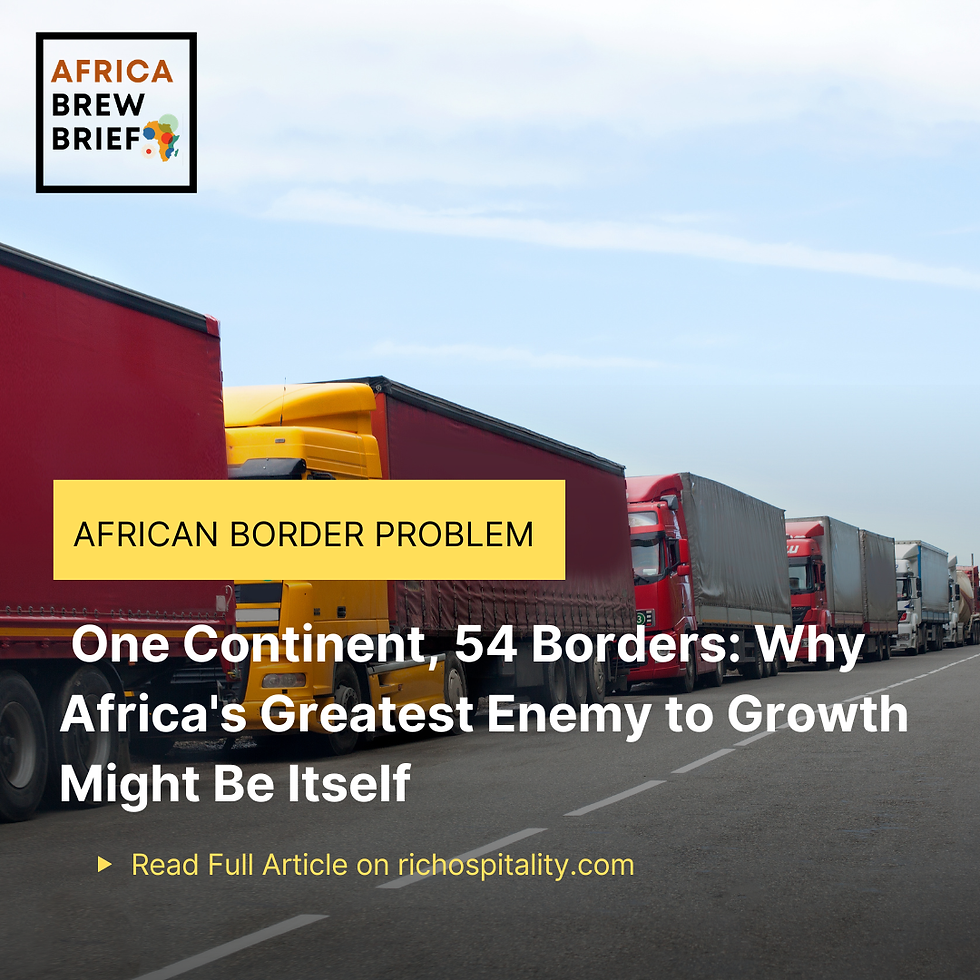
To understand why, you do not need a degree in economics. You need only to look at a map — and count. Fifty-four sovereign nations. Fifty-four sets of customs rules. Fifty-four currencies in circulation. Fifty-four immigration regimes. Hundreds of border checkpoints where trucks sit idle for days, where paperwork multiplies into absurdity, where bribes replace bureaucracy and time bleeds into money that Africa's traders do not have.
The question this article asks is a blunt one: are Africa's 54 borders the single greatest structural barrier to the continent's economic destiny? And can the African Continental Free Trade Area — the most ambitious trade agreement since the creation of the European Union — actually fix it?
---
## What Size Does for an Economy
Before we talk about Africa's fragmentation, it is worth understanding what geographic and economic scale actually does for a country.
Consider the three largest economies in the world by purchasing power and landmass: the United States, China, and Russia.
The United States covers 9.8 million square kilometres across 50 states. A truck leaving Los Angeles can deliver goods to New York — crossing the entire width of a continent — without stopping at a single customs post, without converting currency, without applying for a visa, without navigating a different legal system for commerce. The entire US domestic market of 330 million consumers is, in trade terms, a single room. That frictionless internal market is one of the foundational reasons American companies scale so rapidly. They can grow to enormous size domestically before they ever consider going abroad. The domestic market stress-tests them, capitalises them, and makes them globally competitive.
China is even more instructive. With 1.4 billion people unified under a single economic jurisdiction, Chinese manufacturers enjoy something most African producers can only dream of: a home market large enough to justify industrial-scale investment. A factory in Shenzhen can ship finished goods to Beijing, Shanghai, Chengdu, and Harbin without a single tariff, without a currency exchange, without a customs declaration. The result is the most formidable manufacturing ecosystem in human history. China's internal scale did not just help its economy — it built it.
Russia, despite its well-documented governance challenges, controls 17 million square kilometres — the largest national territory on earth. Its internal resource movement, energy infrastructure, and commodity pipelines operate without cross-border friction. Raw materials extracted in Siberia feed industries in the Urals and the Volga Basin in a closed, duty-free loop that would be structurally impossible if Russia were divided into, say, 20 separate sovereign states each demanding transit fees and paperwork.
The lesson is not subtle. Large, unified economic spaces generate compounding advantages: scale efficiencies, infrastructure investment justification, labour mobility, price harmonisation, and the ability to build companies big enough to compete globally. Borders, by contrast, fragment markets, raise transaction costs, and keep businesses small.
Africa has more international borders than any other continent. And it is paying the price.
---
## Europe Saw This Problem — and Built a Solution
It would be historically dishonest to suggest that borders are a uniquely African problem. Europe, for most of its history, was a patchwork of hostile, heavily fortified nation-states that went to war with each other repeatedly — twice in the twentieth century on a scale that nearly ended civilisation.
After World War Two, European leaders arrived at a remarkable conclusion: economic integration was not just good for growth, it was essential for peace. The thinking was partly idealistic and partly ruthlessly pragmatic. Countries that trade with each other, that share supply chains and depend on each other's consumers, do not go to war with each other. Commerce is the great pacifier.
What began in 1951 as the European Coal and Steel Community — a modest agreement between six nations to share key industrial resources — evolved over seven decades into the European Union: a single market of 27 countries, 450 million consumers, a largely unified legal and regulatory framework, free movement of goods, services, capital, and people, and a common currency shared by 20 of its members.
The results have been transformative. German car manufacturers sell seamlessly into France. French agricultural produce moves freely into Spain. Polish workers can take jobs in Ireland. An entrepreneur in Rotterdam can incorporate a company and trade across the entire continent under a common legal framework. Intra-EU trade accounts for roughly 60% of the bloc's total trade — meaning European countries trade more with each other than with the rest of the world combined.
The EU was not created because European nations liked each other. Many of them had very recently been trying to destroy each other. It was created because the leaders of that generation understood, with hard-won clarity, that fragmentation was an economic and strategic liability that no individual nation could afford to carry indefinitely.
Africa is now attempting something analogous — under far more complex circumstances, with far fewer resources, and against far greater structural odds.
---
## The Daily Reality of African Borders
To understand what African fragmentation actually means in practice, set aside the macroeconomics for a moment and consider the lived experience of an African trader, entrepreneur, or traveller.
An agricultural exporter in Zambia seeking to sell produce to the Democratic Republic of Congo — countries that share a border — must navigate import duties, phytosanitary certificates, customs declarations, potential currency conversion between the Zambian kwacha and the Congolese franc, and border posts that may operate limited hours, be subject to unofficial fees, or simply be understaffed to the point of causing multi-day delays. What should be a commercial transaction between neighbours becomes a bureaucratic expedition.
A businessperson from Nigeria seeking to attend a meeting in Kenya must obtain a visa in advance — something a Nigerian travelling to the United Kingdom on a valid business visa can, in certain corridors, do more predictably. Intra-African air travel is notoriously expensive and poorly routed. For decades, flying between two African cities has frequently required a connection through London, Paris, or Dubai — a geographic absurdity that adds cost, time, and carbon footprint to every business interaction.
Intra-African trade currently accounts for approximately 15–18% of the continent's total trade volume. Compare that to intra-EU trade at 60%, intra-Asia trade at approximately 59%, and intra-North America trade at around 40%. Africa trades less with itself, proportionally, than any other major regional bloc on earth. That is not because Africans lack the desire or the enterprise to trade with one another. It is because the structural barriers make it extraordinarily difficult and expensive to do so.
---
## Dangote Said It Better Than Any Economist Could
No single statement captures the absurdity of African trade fragmentation more powerfully than those made by Aliko Dangote — Africa's richest man, founder of the Dangote Group, and the man who built the largest cement conglomerate on the continent.
Dangote has stated publicly, and on multiple occasions, that it is easier and cheaper for his company to ship goods to Europe than it is to move products across African borders. Read that sentence again. A product manufactured in Nigeria — by Africa's largest industrial group — faces fewer logistical and regulatory barriers reaching consumers in Hamburg or Rotterdam than it does reaching consumers in Ghana, Cameroon, or Côte d'Ivoire.
This is not a minor inefficiency. This is a structural inversion of how a functional continent should operate. It means that Africa's own producers are, in many cases, more connected to foreign markets than to their neighbours. It means that value created on African soil flows outward, rather than circulating and compounding within the continent. It means that African consumers pay more for African goods than they should — and sometimes cannot access them at all — while foreign imports fill the gap.
Dangote's observation is the most eloquent case study for why AfCFTA exists. Because if a man with his resources, his infrastructure, his political capital, and his operational scale says the system is broken, it is broken beyond the capacity of individual enterprise to fix. It requires structural reform at the continental level.
---
## The Hidden Taxes of Fragmentation
The costs of Africa's border problem are not always visible in official statistics. Some of the most damaging are informal.
At many African border crossings, particularly in Central and West Africa, truck drivers routinely pay unofficial fees — call them what they are: bribes — to customs officials, security personnel, and checkpoint operators. Studies by the African Development Bank have identified dozens of unofficial checkpoints along major West African trade corridors where payments are extracted from drivers with no legal basis and no receipt. These payments are not large individually — sometimes a few dollars — but they are relentless and cumulative. A truck making a cross-border journey can encounter ten, twenty, or thirty such checkpoints. The costs accumulate. They are ultimately passed on to consumers. And they make African goods more expensive relative to imported alternatives that arrive via major ports in a single customs clearance.
Beyond corruption, there is the sheer cost of compliance. Preparing export documentation for a shipment crossing multiple African borders can require certificates of origin, phytosanitary and veterinary clearances, customs valuation forms, and import permits — some of which must be obtained from government offices that are understaffed, under-resourced, and, in some cases, not digitised. Small and medium-sized enterprises, which form the backbone of most African economies, frequently lack the administrative capacity to manage this compliance burden. Large multinationals can absorb it. Small African businesses cannot.
Then there is the perishability problem. Africa is the world's most agriculturally endowed continent, yet post-harvest losses across Sub-Saharan Africa are estimated at between 30 and 50% of total production. A significant proportion of that loss occurs not in the field but at border crossings — where perishable goods sit in trucks in the sun while documentation is processed, disputes are resolved, or payments are negotiated. Fresh produce that left a farm in Uganda in perfect condition arrives in Rwanda bruised, degraded, or unsaleable. The farmer absorbs the loss. The continent absorbs the loss.
---
## The AfCFTA: Africa's Answer to Itself
Against this backdrop, the African Continental Free Trade Area — which came into force in January 2021 — represents the most ambitious act of collective economic statecraft in African history.
The agreement, signed by 54 of the 55 African Union member states (Eritrea being the sole holdout), creates a single continental market for goods and services, with the goal of eliminating tariffs on 90% of goods traded between member states, reducing non-tariff barriers, liberalising services trade, and harmonising investment rules and intellectual property protections across the continent.
The numbers attached to AfCFTA's potential are staggering. The World Bank has projected that full implementation could lift 30 million Africans out of extreme poverty by 2035 and boost the incomes of a further 68 million people living on less than $5.50 a day. The UN Economic Commission for Africa has estimated that AfCFTA could increase intra-African trade by more than 50% by 2040. The African Union itself has projected that the agreement could generate a continental GDP uplift of $450 billion by 2035.
These are not small numbers. They represent, if realised, one of the most significant poverty-reduction and wealth-generation events in modern economic history.
The AfCFTA Secretariat, headquartered in Accra, Ghana, has been operational since 2020. The agreement's architecture covers not just tariff reduction but a growing range of complementary protocols: the Protocol on Trade in Services, the Protocol on Investment, the Protocol on Intellectual Property Rights, the Protocol on Competition Policy, and the pioneering Protocol on Women and Youth in Trade — a recognition that AfCFTA's benefits must be distributed equitably across demographics historically excluded from formal trade systems.
A Pan-African Payment and Settlement System (PAPSS) has been developed to address one of the most persistent friction points in intra-African commerce: currency conversion. For decades, two African businesses trading with each other have often had to convert their respective currencies into US dollars and back again — paying conversion fees twice, absorbing exchange rate risk, and routing transactions through correspondent banks in New York or London. PAPSS allows transactions to be settled directly in African currencies, removing the dollar intermediary and dramatically reducing transaction costs.
---
## How Practical Is AfCFTA, Really?
This is where intellectual honesty requires a measure of sobriety.
AfCFTA is, in its design, a genuinely transformative framework. But frameworks do not move goods. Roads move goods. Ports move goods. Functioning customs systems, trained officials, digitised documentation, and the political will to enforce agreements against the short-term interests of protected domestic industries — these are what move goods.
And here, the implementation gap is real and it is wide.
The agreement's tariff liberalisation schedules have been subject to significant delays and renegotiations. Many member states have been slow to submit their tariff offers. Some of the continent's most significant economies — Nigeria, which accounts for roughly 17% of Africa's GDP, took years to sign and has been cautious in its implementation commitments, partly due to pressure from domestic manufacturers concerned about competitive exposure. Ethiopia, East Africa's largest economy, has faced internal conflict that has slowed its trade integration progress. South Africa, the continent's most industrialised economy, has complex interests in protecting certain sectors.
Non-tariff barriers — the customs delays, arbitrary inspections, inconsistent standards, and informal payments described earlier in this article — are in many ways harder to eliminate than tariffs. Tariffs are a legislative act. Non-tariff barriers are often embedded in institutional culture, in administrative capacity gaps, in the economic interests of individuals who benefit from opacity at border crossings. Eliminating them requires not just political agreement but institutional transformation.
Infrastructure remains the continent's most stubborn constraint. Intra-African trade is ultimately limited by what roads, railways, ports, and digital connectivity exist to carry it. The African Development Bank estimates the continent's infrastructure financing gap at between $68 billion and $108 billion per year. AfCFTA cannot conjure railways into existence by eliminating tariffs. The agreement needs to be accompanied by massive, sustained infrastructure investment — and that investment requires capital at a scale that African governments, many of which are managing significant debt burdens in the post-COVID fiscal environment, cannot easily mobilise alone.
There is also the question of productive capacity. Trade liberalisation benefits economies that have something competitive to trade. For many African nations — particularly smaller, lower-income states that are heavily dependent on raw commodity exports — the immediate beneficiaries of open intra-African trade may be the continent's more industrialised economies: South Africa, Egypt, Nigeria, Kenya, Morocco. Without deliberate industrial policy, AfCFTA risks accelerating intra-African inequality even as it grows aggregate continental trade. The agreement's architects are aware of this risk; addressing it is a work in progress.
---
## The Vision and the Work That Remains
AfCFTA is best understood not as a solution but as a platform — a framework within which solutions can be built, if the political will, the investment, and the institutional capacity to execute are consistently applied over a generation.
The European Union took approximately four decades from the Treaty of Rome to the completion of its single market. It was not a linear journey. There were crises, opt-outs, renegotiations, and moments at which the entire project seemed close to unravelling. The EU's success was not inevitable — it was constructed, iteratively and imperfectly, by political leaders who were committed to the principle that integration served their nations' long-term interests even when it demanded short-term sacrifice.
Africa's political economy is more complex. The continent's 54 nations represent vastly more diverse stages of development, institutional capacity, and economic structure than the EU's founding members did. The AfCFTA must build a single market across democracies, authoritarian states, fragile post-conflict environments, and everything in between. It must do so while managing colonial-era border legacies that divided ethnic groups, disrupted regional trade networks, and created nation-states whose boundaries reflect nineteenth-century European negotiating tables rather than African economic geography.
None of that makes AfCFTA futile. It makes AfCFTA necessary — and it makes the work of implementation, capacity-building, infrastructure investment, and institutional reform the defining economic challenge of this generation of African leadership.
---
## The Bottom Line
Fifty-four borders are not just lines on a map. They are friction. They are cost. They are lost time, spoiled produce, frustrated entrepreneurs, and deferred prosperity. They are the reason that a continent of 1.4 billion people, sitting on the world's largest reserves of the minerals that will power the twenty-first century economy, accounts for less than 3% of global trade.
Russia, China, and the United States did not become economic superpowers despite their size. They became superpowers because of it — because the absence of internal borders allowed capital, labour, goods, and ideas to flow freely across vast productive territories, creating the scale efficiencies and market depths that drive industrial growth.
Europe, which had spent centuries destroying itself with borders, dismantled them deliberately — and in doing so created one of the most prosperous economic blocs in human history.
Africa's borders are not insurmountable. But they will not dissolve on their own. They require exactly what AfCFTA provides at the level of principle: the recognition that the continent's greatest untapped market is itself, that African producers' most important customers are other Africans, and that the road to global economic relevance runs, first and most urgently, through each other.
Aliko Dangote should not find it easier to ship to Hamburg than to Accra. That is not an African story. It is an African problem — and AfCFTA, implemented with urgency and with honesty about its gaps, is Africa's best answer to it.
The continent does not need the world to open its doors. It needs to open its own.
Published by RIC Brands | Africa Trade & Growth Intelligence*


Comments