
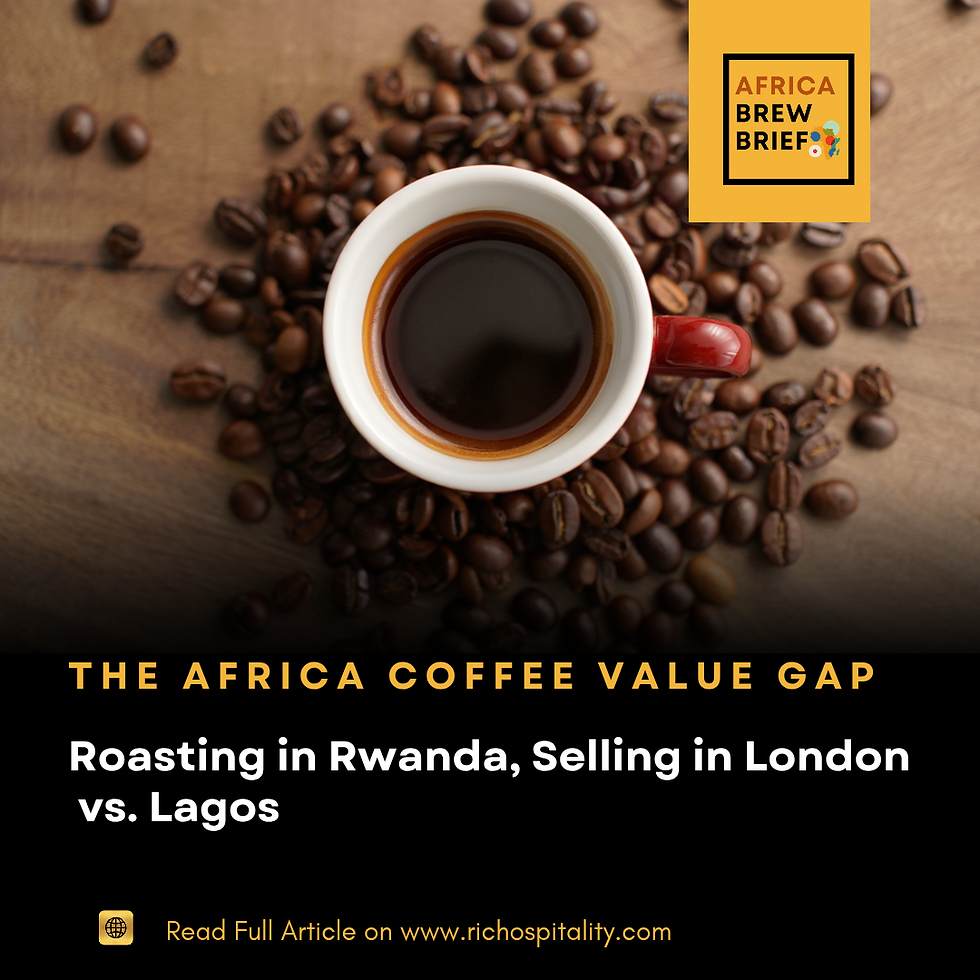
The Coffee Value Gap: Roasting in Rwanda, Selling in London vs. Lagos
- Wilbert Frank Chaniwa
- Jul 21
- 6 min read

Investigative agribusiness intelligence | Rooted in Africa. Built for the World.*
---
Rwanda sits at a decision point every serious African agribusiness eventually faces: where does value-added processing actually pay, and where does it just look good on a strategy deck. Roasting coffee close to the farm gate is the correct instinct. But the market you ship it to determines whether that instinct becomes a margin captured at home — or another line item in the value gap Africa keeps handing to someone else's port.
**THE BASE CASE**
Rwanda exported 23,860 tonnes of green coffee in 2025, earning $148.6 million — a 39% rise in volume and 65% rise in revenue year-on-year, with the average export price climbing 19% to $6.20 per kilogram. That makes 2025 the most profitable year in the country's coffee history, with NAEB targeting 32,000 tonnes and $192 million by 2029. Farmers earned an average of Rwf900 ($0.62) per kilogram of cherry, above the Rwf600 government floor. Only around 5% of the harvest is consumed domestically. This is an export economy — which means the roasting question is not *whether* value gets added, but *where*, and who keeps it.
**TWO LANES, TWO DIFFERENT ECONOMIC LOGICS**
*Route A: Rwanda green beans, roasted in London.* This is the default lane today — Rwanda sells raw, the UK roaster captures the margin. Belgium is currently Rwanda's largest single buyer at 4,737 tonnes worth $32.29 million, and Europe remains the principal market. London specialty roasters such as Origin Coffee build their entire brand on direct-trade East African sourcing; Square Mile anchors its reputation on precision roasting for London's specialty segment. Both extract Rwandan-grade green coffee and keep the roast-to-retail margin.
*Route B: Rwanda-roasted coffee, exported to Lagos.* This inverts the model — value-add happens at origin, and Rwanda exports the finished, branded product instead of the raw commodity.
These two routes are not symmetrical, and the reason is physics as much as finance.
**WHY FRESHNESS, NOT TARIFFS, IS THE REAL CONSTRAINT**
Roasted coffee stales measurably within two to four weeks; green coffee stores stably for a year or more. A four-to-six week sea freight transit from Kigali to a UK port works for green beans and is commercially difficult for roasted ones — which is exactly why the world's roasting infrastructure has clustered at destination markets, not origin. That is the real reason London keeps the roasting margin on African coffee: distance turns origin-roasting-for-Europe into a niche, air-freighted proposition rather than a volume business.
Lagos changes the arithmetic. The distance and transit time from Kigali is a fraction of Kigali-to-London, and AfCFTA corridor development is actively cutting transit times and logistics costs along routes including Lagos-Abidjan. Origin-roasted, Rwanda-branded coffee for Lagos is structurally viable in a way it currently isn't for London — the freshness survives the trip.
**MARKET SIZE: NOT A FAIR FIGHT — BUT THE WRONG COMPARISON**
London isn't close. UK out-of-home coffee spend is forecast at £6.1 billion in 2025, up 4.1% year-on-year, with weekly out-of-home coffee occasions now covering 15.1% of consumers — over 7.9 million regular buyers — and roughly 98 million cups consumed daily nationwide.
Nigeria is still an emerging category. National coffee consumption sat around 40,200 tonnes-equivalent in 2023 and is projected to stay roughly flat through 2028, with instant coffee still dominant on purchasing-power grounds even as genuine café culture takes root in Lagos and other major cities. Nigeria's coffee market is forecast to grow by only about $16 million in absolute terms over the next five years, at roughly 7.4% growth in 2025 off a small base.
London: a mature, £6bn-plus market growing modestly. Lagos: a nascent, low-hundred-million-dollar market growing off a tiny base, backed by the scale of 220 million people and the youngest large population on the continent.
**WHICH IS MORE PROFITABLE?**
Per kilogram, London wins outright — specialty bags retail around £24-£30/kg against Rwanda's $6.20/kg FOB. But the real question is who captures that margin, and today it almost never is Rwanda. For a Rwanda-based roasting operation, Lagos is the more profitable route on a margin-capture basis, for three reasons: shorter and cheaper logistics that let origin-roasted product actually arrive fresh; AfCFTA tariff preference removing the duty layer that currently makes intra-African roasted trade uncompetitive against European re-exports; and a specialty segment still being defined rather than one already owned by entrenched, well-capitalised incumbents.
London remains — and will remain — Rwanda's largest hard-currency earner through raw export. Lagos is the better route for building a branded, margin-owning African roasting business. The strategic answer is sequencing: fund the balance sheet on London/Europe green exports, build the brand and capture roasting margin through Lagos and intra-African corridors.
**HOW A LONDON ROASTER COMPETES ON PRICE USING AFRICAN GREEN BEANS**
Three structural advantages currently sit with London, not Kigali: near-zero effective friction on green coffee entering the UK versus the documentation and non-tariff barriers still facing intra-African movement; established freight consolidation and futures hedging against ICE pricing; and proximity to the premium consumer, letting London roasters sell freshness and provenance story simultaneously. This is precisely the imbalance AfCFTA is built to correct — for intra-African trade, not the London relationship, which stays a raw-export lane for the foreseeable future.
**THE CHALLENGES ON EACH ROUTE**
Rwanda to London: price volatility (Arabica roughly doubled between April 2024 and March 2025 before settling); margin capture stays offshore; ageing tree stock, with roughly 39% of Rwanda's coffee trees now over 30 years old, threatens long-run supply even as quality peaks — 2025's record lot fetched $88.18/kg at the Best of Rwanda auction.
Rwanda-roasted to Lagos: thin, underdeveloped trade lanes — Rwanda-Nigeria coffee trade is not yet an established corridor at scale; currency risk on both sides; a consumer market where instant still dominates; and uneven AfCFTA implementation on the ground, with even AfCFTA-aligned operators noting that policy has not yet translated fully into measurable economic impact, dependent heavily on national committee effectiveness.
**COMPETITION AND LONG-TERM SUSTAINABILITY**
London is structurally mature and fiercely contested: Costa, Starbucks, Caffè Nero, Pret and Greggs dominate volume, while WatchHouse, Black Sheep Coffee, Knoops and Gail's take share in the premium tier, and drive-thru keeps expanding — Costa alone added 27 sites to reach 373 in the past year. A Rwanda-linked brand can win a premium niche here on provenance, but not on cost or scale.
Lagos has comparatively little specialty competition today — the real competitor is the beverage category itself, not other premium roasters. Multinational instant brands are beginning to penetrate, but the specialty lane is largely undefined. That is the opportunity: a first-moving, well-capitalised African roaster can set the category before multinationals fully arrive, backed by demographic tailwinds — Nigeria's youth bulge and urbanisation — stronger than almost any comparable market on the continent.
**HOW AFCFTA PRACTICALLY HELPS**
Beyond tariff mechanics — 90% of tariff lines liberalised over five to ten years depending on development status — the proof point already exists in coffee specifically. The first-ever AfCFTA Certificate of Origin was issued to Rwanda's Igire Coffee, for coffee products destined for Ghana. That is the exact template a Rwanda-to-Lagos roasting and export strategy would follow. Agricultural processing under AfCFTA could lift export earnings by as much as 42.3%, with East African coffee regions specifically identified as positioned to capture roasting and packaging premiums rather than exporting raw. Practically: lower duty on roasted coffee moving Kigali to Lagos, harmonised rules of origin qualifying Rwandan-processed product as genuinely African rather than an external import, and corridor infrastructure directly addressing the freshness-window problem that currently keeps roasting offshore.
---
This is the value gap the coffee trade rarely names honestly: London pays more per kilogram, but Africa keeps giving that margin away at the port. The Rwanda-Lagos lane is smaller today — but it is the one where a Rwandan roaster can own the roast, not just the harvest.
**ORIGIN CUP: RWANDA EDITION**
If this is the argument you want to see settled over an actual pour rather than a spreadsheet, that's exactly what the Origin Cup Rwanda Edition is built for — curated by Nibbio Coffee, with 1000 Hills Products as supporting partner, bringing Rwandan producers, roasters and buyers into the same room to build the direct trade lines this piece argues Rwanda needs more of. The Rwanda High Commission will also be in the room. Worth being there.
---
*Africa Brew Brief: Investigating the trade, policy, and value chains shaping Africa's agribusiness future. Follow the series for more deep dives at the intersection of African trade sovereignty and global market access.*


Comments