
Sweet Colonialism: Why 'Africa's Largest Sugar Producer' Has Never Once Been African - & what the Dangote Sugar Rebellion teaches Africa
- Wilbert Frank Chaniwa
- Jul 11
- 8 min read

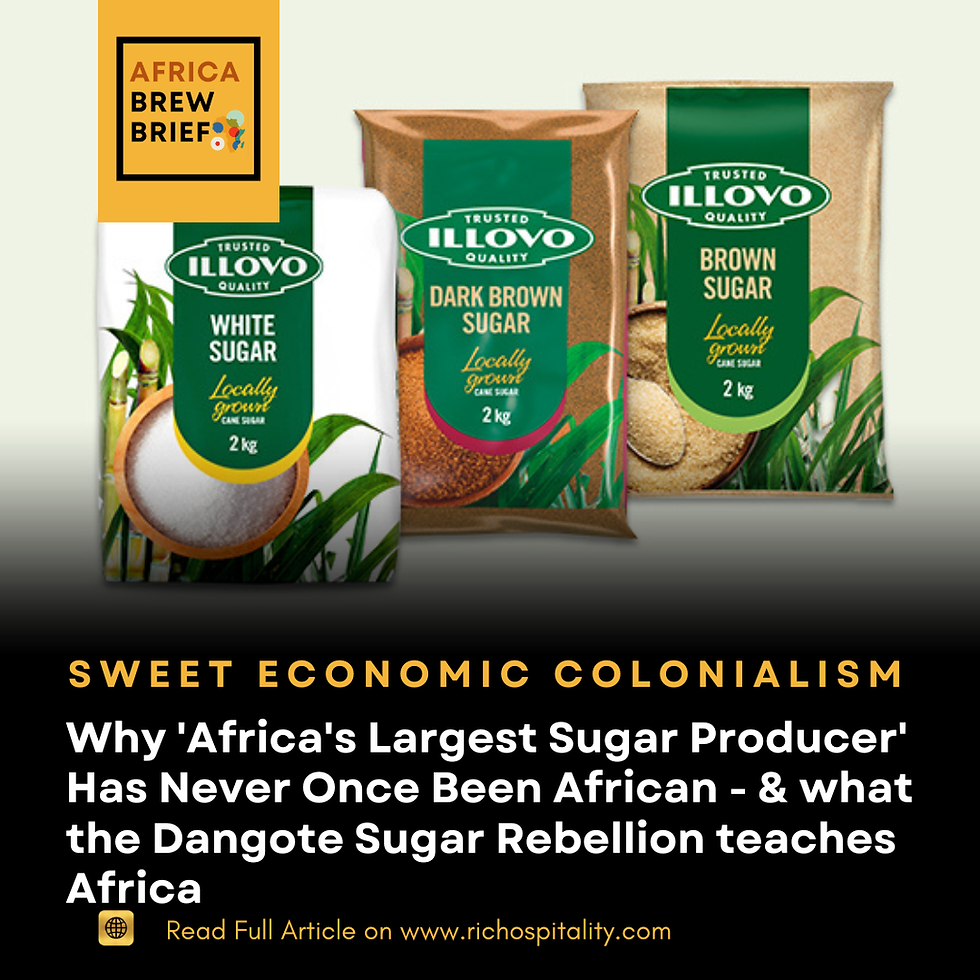
The Empire Hiding in Plain Sight
Every time someone in Lusaka, Blantyre, Maputo, or Mbabane stirs sugar into their tea, there's a reasonable chance that sugar was grown, milled, and sold to them by a company ultimately answering to a boardroom in uMhlanga — which answers to a holding company in London — which answers, in the end, to one family's trust in the United Kingdom, endowed by a Canadian bread baron nearly seventy years ago.
That company is Illovo. Its parent is ABF Sugar, the sugar division of Associated British Foods plc. And ABF is controlled by the Weston family through Wittington Investments, a private vehicle that traces its money back to a Toronto delivery-route purchase in 1882.
This isn't a conspiracy story. It's public record, published in annual reports, Companies House filings, and stock exchange disclosures. But the scale of it — one family's holding company sitting atop the sugar supply of six African nations, moving profits through Mauritius and the Netherlands, while smallholder outgrowers in Malawi and Zambia fight for land recognition — deserves to be told plainly, in one place, to the people who are supposed to be building Africa's own agribusiness champions.
---
## The Long Arc: From Reynolds Brothers to a Six-Country Sugar Grid
The company's roots go back to 1891, when Charles George Smith set off the chain of consolidations that eventually became Illovo Sugar Africa — a lineage Illovo itself now markets as "130-plus years of an African sugar giant." The path ran through several corporate identities: the 1975 merger of CG Smith, Gledhow Sugar, and Reynolds Brothers into CG Smith Sugar; the 1977 acquisition of the Illovo and Noodsberg mills from Tate & Lyle; the 1994 rename to Illovo Sugar Limited; the pivotal 1997 purchase of Lonrho Sugar Corporation, which brought Malawi's Nchalo and Dwangwa estates — originally seized from local communities by the Malawian government in the 1960s–70s — into Illovo's hands; ABF's controlling stake in 2006; and full ownership by 2016, when Illovo was formally absorbed into what's now branded ABF Sugar.
Today the footprint spans Eswatini, Malawi, Mozambique, South Africa, Tanzania, and Zambia, with cane sourced from company-owned farms and independent growers alike, plus co-products like potable alcohol, furfural, and grid electricity. Across ABF Sugar as a whole — including UK and Spanish operations — the group runs 29 plants in 10 countries and employs around 40,000 people.
On African soil alone, the plant list is a small industrial empire in itself: Sezela, Umzimkulu, and Eston in South Africa; Nchalo and Dwangwa in Malawi; Kilombero and Mtibwa in Tanzania; Nakambala in Zambia; Maragra in Mozambique; and Mhlume and Ubombo in Eswatini.
## The Numbers: What "Africa's Largest Sugar Producer" Actually Means
Illovo produces over 1.7 million tonnes of sugar annually, generating roughly 90% of its own energy needs by burning bagasse. Country by country, the scale is staggering:
- **South Africa** — three mills with a combined crushing capacity of 5.2 million tons of cane per year, run off eight company-owned "Mill Cum Planter" farms plus two leased estates.
- **Zambia** — Nakambala/Zambia Sugar, the largest single-mill cane sugar producer in Africa, listed on the Lusaka Securities Exchange with ABF Sugar holding 75%.
- **Malawi** — the Nchalo and Dwangwa estates span over 34,000 hectares combined, and Illovo is effectively Malawi's only sugar producer.
- **Tanzania** — Kilombero Sugar Company is 75% Illovo-owned, with the Government of Tanzania holding the remaining 25%; an ongoing expansion is set to lift output from around 130,000 to roughly 270,000 tonnes annually.
- **Mozambique** — Maragra Açúcar, majority Illovo-owned, produces around 80,000 tons of sugar annually from more than 460,000 tons of cane.
An independent economic-impact study commissioned by Illovo put its total economic footprint across its six African countries at R28.6 billion in the 2020/21 financial year. As a standalone unit, Illovo Sugar Africa's annual revenue was reported at $13.1 billion in 2026.
## The Investment Case — And Its Shadow
Illovo's defenders point, correctly, to real capital deployed on the ground. Since 2008, the company invested £150 million to double production capacity in Zambia, creating what it called the largest sugar mill in Africa and supporting more than 5,000 jobs. The IFC is currently partnering with Illovo Sugar Malawi to cut water and energy consumption while supporting thousands of farmer and supply-chain jobs.
But the same investment machine has generated two of the most-cited corporate accountability cases in African agribusiness history — and any founder studying this playbook needs to understand both sides.
**The tax story.** In 2013, the charity ActionAid published a report alleging that Zambia Sugar paid virtually no corporate tax between 2007 and 2012 despite posting $123 million in profits, in a country where the statutory rate is 35%. The charity documented payments routed to sister companies in Ireland, Mauritius, and the Netherlands — including a Mauritius holding company that, when contacted, turned out to have exactly one employee. ActionAid estimated Zambia lost roughly $17.7 million in tax revenue in the years following ABF's takeover of Illovo. ABF's rebuttal was that capital allowances tied to its £150 million Zambian investment legitimately reduced the tax bill to near zero, and had nothing to do with avoidance. Both things — real investment and near-zero tax contribution — were true at once. That's the uncomfortable lesson.
**The land story.** In October 2013, Oxfam named Illovo, alongside Coca-Cola and PepsiCo, in a report on land rights and land-grab risk in global beverage and sugar supply chains. Illovo's Malawi operations trace back to plantations acquired from Lonrho, which had itself taken roughly 40,000 hectares from the Malawian government decades earlier — land from which communities had already been displaced before Illovo's arrival. Independent academic research on the later Zambian expansion found a similar pattern: the promised "virtuous circle" of foreign sugar investment often fails to reach the rural poor, undercut by tax avoidance, wage suppression, and benefits that don't trickle down — even where outgrower schemes carry Fairtrade certification, decision-making power tends to concentrate with local elites. To its credit, Illovo responded to the pressure campaign by adopting a Free, Prior and Informed Consent policy in 2014, and has since run land-mapping and outgrower-certification projects with international donors in Malawi.
## Enter Dangote: The Man Who Decided Nigeria Would Stop Renting Its Own Sugar
If Illovo is the old colonial-adjacent model — foreign capital, foreign holding structure, profits repatriated through European tax jurisdictions — Dangote Sugar is the loudest African answer to it, even if the answer is still a work in progress.
The starting point was policy, not just ambition: Nigeria's Sugar Master Plan, launched in 2012, aimed to raise local production and cut import dependence. Dangote Sugar Refinery, chaired by Aliko Dangote, became its most committed private-sector executor.
The scale of the bet is now enormous:
- Over $700 million invested in Dangote's backward integration program, targeting 700,000 metric tonnes of local output within five years — roughly half of current national demand — aimed at plugging a foreign-exchange hole after Nigeria spent an estimated ₦953.9 billion on raw sugar imports in a single recent 12-month period.
- Dangote Sugar owns 32,000 hectares in Numan (Adamawa State), 68,000 hectares in Tunga (Nasarawa State), and 25,000 hectares in Lau/Tau (Taraba State), with ambitions to reach 24,200 hectares under cultivation at Numan alone by 2029.
- The Numan factory's crushing capacity has been pushed from 3,000 tonnes of cane per day to 9,800, with a further upgrade toward 15,000 underway, and the plant is expected to generate 32 megawatts of its own electricity once complete.
- The ultimate goal, branded the "Dangote Sugar for Nigeria Master Plan," is 1.5 million metric tonnes per annum of refined sugar from locally grown cane — a figure that would make Dangote's *domestic* output alone comparable to Illovo's *entire six-country* production.
- On tax — the exact issue that dogs Illovo — Dangote's numbers point the opposite direction: over N249 billion paid in taxes across a recent five-year period.
- On jobs and community: roughly 300,000 direct and indirect jobs projected once backward-integration projects are complete, an outgrower scheme already covering over 1,000 farmers, and CSR spending on roads, scholarships, and community support surpassing N1 billion in recent years.
It isn't a clean fairytale — insecurity, communal disputes, and land ownership disagreements between host communities and operators continue to challenge backward-integration plans across Nigeria's sugar belt, and Dangote's Taraba project has itself stalled over unresolved community payment issues. But the structural difference from Illovo is the point: the capital, the tax base, and the strategic intent are Nigerian-anchored, even where the technology and some inputs are imported.
## What Other African Agribusinesses Should Take From This
**1. Ownership structure is destiny.** Illovo's profits flow up through ABF to Wittington Investments to the Garfield Weston Foundation and family shareholders in London and Toronto. Dangote Sugar's profits flow to a Lagos-headquartered, locally listed conglomerate whose controlling shareholder lives and reinvests on the continent. Where the holding company sits determines where the surplus value — and the reinvestment decisions — ultimately land. For any African founder building a trade or processing business, the question isn't just "can I attract foreign capital," it's "who controls the entity that controls the entity."
**2. Backward integration is the real moat, not the refinery.** Dangote didn't just build a bigger factory — it bought the land, financed the irrigation, and built the outgrower relationships upstream of the mill gate. Illovo did the same thing a century earlier; the difference now is who's doing it *today*, with today's capital and today's leverage.
**3. Land and tax transparency are not PR problems — they're structural liabilities.** The advocacy campaigns against Illovo didn't stay in NGO reports; they shaped Zambian and Malawian public opinion for a decade and forced policy changes that cost more in reputational capital than they would have cost to build in from day one. Any RACS-style cold chain or trade infrastructure play across Rwanda–Uganda–Tanzania–Kenya should build land-rights and local tax transparency into the founding documents, not retrofit them after a report goes viral.
**4. Outgrower schemes only work if farmers actually hold power in them.** The research is consistent: certification and outgrower "partnership" branding mean little if representation defaults to local elites and poorer participants see limited benefit. A genuinely Africa-owned agribusiness has the chance to design outgrower governance differently from the start — cooperative equity stakes, transparent pricing formulas, elected (not appointed) farmer representatives.
**5. Scale is achievable without dependency.** Dangote Sugar's trajectory — from a modest Numan plant to a 1.5-million-tonne national ambition within a decade — is proof that African capital, deployed with the same seriousness ABF applies across six countries, can compete on the same order of magnitude. The tools — backward integration, cogeneration, outgrower financing — are not proprietary Western know-how. They are simply capital-intensive and patient, which is exactly the discipline RIC Brands' own agribusiness and trade thesis is built around.
---
**RIC Brands works at the intersection of African commodity trade, agribusiness infrastructure, and market-facing brand-building — connecting the founders, cooperatives, and institutions who are ready to own their own value chains, not just supply someone else's.**
*Ownership isn't a footnote in African agribusiness. It's the whole story.*
#GrowAfrica #BrandAfrica #TradeAfrica #AfricanAgribusiness #SugarIndustry #DangoteSugar #IllovoSugar #ABF #FoodSovereignty #AfricaTrade #RICBrands
---
Africa Brew Brief | RIC Brands — RIC Brands' intelligence platform tracking African agribusiness, commodity trade, and origin stories — reporting the ground truth that shapes better decisions for African agriculture, trade, and investment. Published for buyers, investors, policymakers, and the people building Africa's food future. Follow the brief: https://share.google/vnz8ZqMf6ujiKPr4j | wilbert@ricbrands.com


Comments