
Ethiopia: The Unconquered Nation Rising Again — A World-Class Destination for Trade, Investment, and Vision
- Wilbert Frank Chaniwa
- Jun 6
- 13 min read

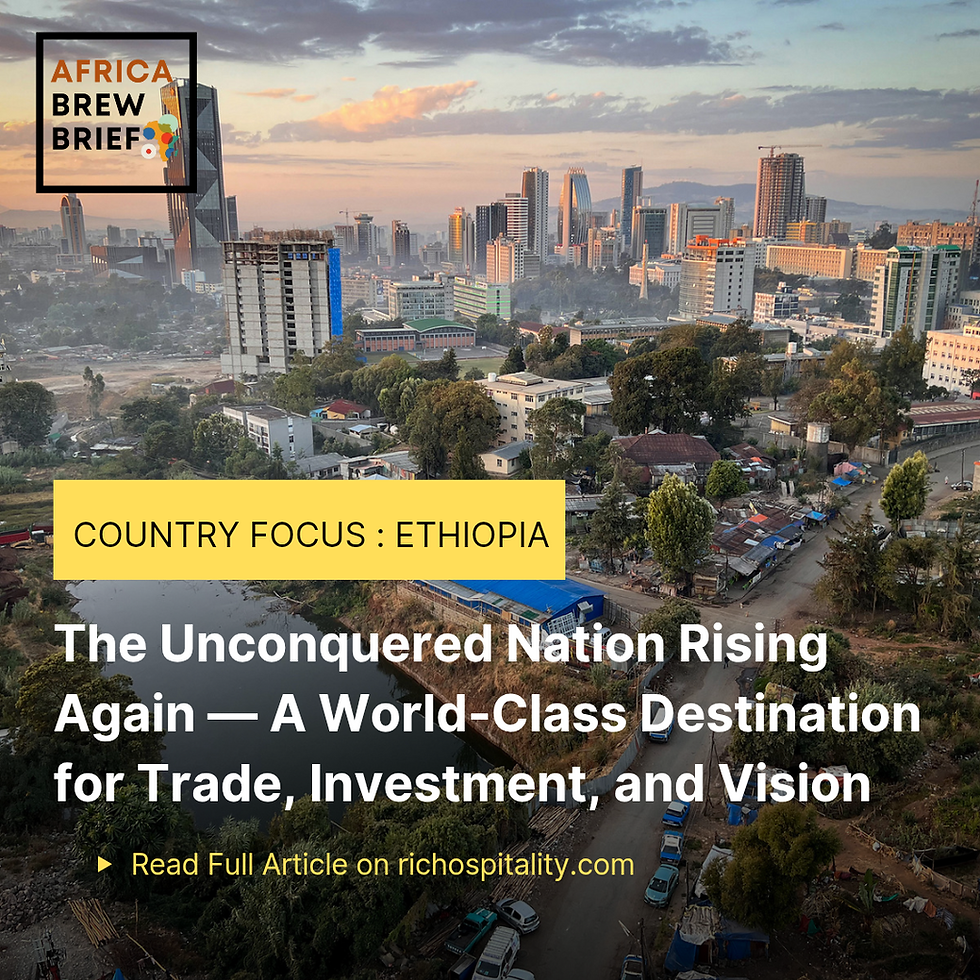
By RIC Brands | Africa Trade & Investment Intelligence
---
There is a particular kind of confidence that belongs only to nations that have never been broken. Ethiopia carries that confidence in its bones. It is the oldest independent country in Africa, one of the oldest civilisations on Earth, and today — with over $18.6 billion in foreign direct investment attracted over the past five years, a state airline that just won Africa's best, and the continent's wealthiest man betting billions on its future — it is rapidly becoming the most compelling trade and investment destination on the continent.
This is not a story of potential. It is a story of arrival.
---
## A Nation That Was Never Colonised
To understand why Ethiopia commands a different kind of respect in Africa and across the world, you must begin with the Battle of Adwa.
On 1 March 1896, Emperor Menelik II led Ethiopian forces to a decisive, historic victory over the invading Italian army — the first time in modern history that an African nation had defeated a European colonial power on the battlefield. More than 100,000 Ethiopian soldiers, fighting for their sovereignty, shattered the myth of European invincibility and sent a message across the continent that Africa could and would resist domination. The world took notice.
While the rest of the continent was carved up and colonised at the Berlin Conference, Ethiopia stood alone and free. It was the only African country — alongside Liberia — never subjected to formal colonisation, and its seat at the League of Nations and later at the founding of the Organisation of African Unity in 1963 reflected a moral authority that no other African nation could claim in the same way.
That legacy is not merely ceremonial. It is constitutional. It shaped a people who understand sovereignty not as a gift granted by others, but as a right defended through sacrifice. For investors and trade partners, that heritage translates into a counterpart with institutional memory, national pride, and a strategic worldview that thinks in generations rather than quarters.
Ethiopia's capital, Addis Ababa, is home to the African Union headquarters — a reflection of the nation's enduring role as Africa's diplomatic and political centre of gravity. The city's status as host of the African Union offers Ethiopia a unique comparative advantage [Ifa](https://www.ifa.gov.et/2026/03/30/ethiopias-investment-surge-and-the-strategic-repositioning-of-addis-ababa-as-africas-diplomatic-economic-nexus/) in continental diplomacy and economic integration that no other investment destination on the continent can replicate.
---
## The Birthplace of Coffee — and of a $2.7 Billion Export Story
Long before the first espresso was pulled in Milan or the first flat white served in London, a goat herder in the forests of Ethiopia's Kaffa region noticed that his animals became unusually energetic after eating red berries from a particular tree. The region of Kaffa in Ethiopia is the birthplace of Arabica coffee, the most popular coffee species worldwide. [Colipse](https://colipsecoffee.com/blogs/coffee/ethiopian) That discovery — told and retold across centuries — gave the world its most beloved beverage, and Ethiopia has never stopped producing it with unmatched excellence.
Today, Ethiopian coffee grows at high altitudes in Sidamo, Yirgacheffe, Kaffa, Harar, and more, with unique terroir and diverse microclimates. [Colipse](https://colipsecoffee.com/blogs/coffee/ethiopian) Ethiopian coffee includes 6,000 to 15,000 heirloom Arabica varieties that are wild, indigenous, non-hybrid, or traditionally cultivated [Colipse](https://colipsecoffee.com/blogs/coffee/ethiopian) — a biodiversity of flavour that no other coffee-producing country on earth can match.
The commercial story is just as compelling. Ethiopia's coffee industry now generates USD 2.7 billion in revenue, benefitting millions of farmers and reinforcing the country's global standing as the birthplace of coffee. [FurtherAfrica](https://furtherafrica.com/2025/09/09/ethiopias-coffee-industry-records-usd-2-7b-in-exports/) Ethiopia's coffee production for marketing year 2025/26 is projected to reach 11.6 million 60-kg bags, supported by favourable weather, increased productivity from rejuvenated trees, and the use of improved inputs such as high-yielding seedlings. Export volumes are forecast to rise to 7.8 million bags, driven by strong global prices and policy reforms that expanded direct access for producers and exporters to international markets. [USDA](https://apps.fas.usda.gov/newgainapi/api/Report/DownloadReportByFileName?fileName=Coffee+Annual_Addis+Ababa_Ethiopia_ET2025-0014)
Coffee accounts for over a quarter of Ethiopia's export earnings and provides income for about 15 million people, most of them smallholder farmers. [issuu](https://issuu.com/bisrat.legesse/docs/report.1b742334.pptx/s/13572363) The country's top buyers span Germany, the United States, Saudi Arabia, Japan, South Korea, Belgium, and the UAE — a buyer profile that tells you everything about the quality premium Ethiopian coffee commands.
Guided by a 15-year Comprehensive Coffee Development Strategy, Ethiopia aims to become the world's second-largest coffee producer and exporter by advancing sustainability and boosting production. [USDA](https://apps.fas.usda.gov/newgainapi/api/Report/DownloadReportByFileName?fileName=Coffee+Annual_Addis+Ababa_Ethiopia_ET2025-0014) For traders, roasters, importers, and retail brands seeking traceable, premium African origin, Ethiopia is not a frontier market. It is the market.
---
## The Geography of Advantage
Ethiopia sits at the crossroads of Africa, the Middle East, and the Indian Ocean trade routes — a geographic position that has made Addis Ababa one of the world's great transit hubs and given Ethiopian commerce a natural reach that most nations could only dream of.
The country shares borders with six nations: Eritrea, Djibouti, Somalia, Kenya, South Sudan, and Sudan. Its proximity to the Port of Djibouti — through which the majority of its imports and exports flow — gives it effective sea access despite being landlocked. Ethiopia's geographic position, bordering Djibouti and the Red Sea, makes it a logistics and trade hub for the Horn of Africa. [Africagrowthforum](https://africagrowthforum.org/investment-opportunities-in-ethiopia/)
With a population of more than 120 million, Ethiopia is Africa's second-most populous nation. Its size, combined with rapid urbanisation, creates strong demand for housing, infrastructure, and consumer goods. [Africagrowthforum](https://africagrowthforum.org/investment-opportunities-in-ethiopia/) It is also Africa's seventh-largest economy, with a nominal GDP of roughly $126 billion according to World Bank estimates for 2024. [African Business](https://african.business/2026/05/innov-africa-deals/ethiopias-hidden-tech-awakening)
For any investor or exporter looking to access East Africa, the Horn, or the broader African continent, Ethiopia is not a consideration. It is a cornerstone.
---
## $18.6 Billion in Five Years: The Investment Surge
The numbers are no longer a projection. They are a verdict.
Ethiopia attracted a total of $18.6 billion in FDI over the past five years, ranking just behind Egypt as Africa's second-largest investment destination. The country also recorded $4 billion in inflows during the 2024 to 2025 fiscal year, marking a 22.7 per cent year-on-year increase. [Radicalleap](https://www.radicalleap.com/2026/ethiopia-emerges-second-largest-investment-destination-attracting-18-6-billion-in-5-years/)
In March 2026, the country hosted its fourth "Invest in Ethiopia" Forum under the theme *Ethiopia: Ready for Business*. The results exceeded all expectations. The Invest in Ethiopia 2026 Forum concluded with the signing of major investment agreements exceeding $13 billion across key sectors of the economy — far exceeding the initially anticipated $2.4 billion. [Investethiopia](https://investethiopia.gov.et/invest-in-ethiopia-2026-forum-2/) The forum brought together over 800 investors from more than 50 countries. [Ifa](https://www.ifa.gov.et/2026/03/30/ethiopias-investment-surge-and-the-strategic-repositioning-of-addis-ababa-as-africas-diplomatic-economic-nexus/) The previous Invest in Ethiopia 2025 Forum had resulted in $1.6 billion worth of agreements, all of which have since become operational and are contributing to national economic growth. [Mofed](https://www.mofed.gov.et/blog/invest-in-ethiopia-2026-forum-wraps-up-with-over-13-billion-in-investment-commitments/)
What is driving this confidence? A combination of genuine structural reform and long-term demographic inevitability. These investments reinforce the objectives of Ethiopia's Homegrown Economic Reform Agenda, which prioritises macroeconomic stabilisation, private sector development, and structural transformation. Since its inception in 2019, the reform programme has sought to liberalise key sectors, enhance the business environment, and attract foreign direct investment. The 2026 forum results suggest that these reforms are beginning to yield tangible dividends. [Ifa](https://www.ifa.gov.et/2026/03/30/ethiopias-investment-surge-and-the-strategic-repositioning-of-addis-ababa-as-africas-diplomatic-economic-nexus/)
The regulatory architecture has been transformed at pace. Ethiopia's National Bank restructured the foreign-exchange regime in 2024, replacing the centrally managed system with a market-based framework that allows banks to negotiate exchange rates freely. [Chambers and Partners](https://practiceguides.chambers.com/practice-guides/investing-in-2026/ethiopia/trends-and-developments/O23716) The 2025 amendment to the Banking Business Proclamation enables foreign banks to acquire up to a 49% stake in domestic financial institutions or to establish wholly owned subsidiaries. [Chambers and Partners](https://practiceguides.chambers.com/practice-guides/investing-in-2026/ethiopia/trends-and-developments/O23716) A new directive also authorises foreign investors to export raw coffee, oilseeds, and livestock — sectors previously reserved exclusively for domestic operators. [Chambers and Partners](https://practiceguides.chambers.com/practice-guides/investing-in-2026/ethiopia/trends-and-developments/O23716)
The Ethiopian Securities Exchange opened in January 2025, with three companies already listed — Wegagen Bank, Gadaa Bank, and Ethio-Telecom — with many more in the pipeline. [Chambers and Partners](https://practiceguides.chambers.com/practice-guides/investing-in-2026/ethiopia/trends-and-developments/O23716) Capital markets, once an abstract concept in Ethiopian business life, are now operational.
---
## Dangote Bets the House on Ethiopia
No single investment story captures Ethiopia's current trajectory more powerfully than Aliko Dangote's escalating commitment to the country. Africa's wealthiest man has not simply invested in Ethiopia. He has made it his second-largest strategic priority on the entire continent.
It began with cement. Dangote announced a $400 million plan to expand his cement operations in Ethiopia, funding a second production line at the Mugher plant approximately 100 kilometres from Addis Ababa, increasing its annual capacity from 2.5 million tonnes to 5 million tonnes. [NTU Singapore](https://www.ntu.edu.sg/cas/news-events/news/detail/dangote-to-invest-us-400m-in-ethiopia-as-reforms-boost-confidence) Notably, Dangote was candid about the difficulties the company had navigated: "Despite the ups and downs, we have successfully repaid all our loans and repatriated our profit," he told reporters in Addis Ababa. [allafrica](https://allafrica.com/stories/202502170152.html) That declaration of successful repatriation — at a time when many investors were cautious about Ethiopia's foreign exchange environment — was a powerful signal to the wider investment community.
Then came fertiliser — and on an entirely different scale. Ethiopian Investment Holdings and Dangote Group signed a comprehensive shareholders' agreement to develop, construct, and operate a world-class urea fertiliser production complex in Gode, Ethiopia. Under the partnership structure, EIH holds a 40% equity stake while Dangote Group maintains 60% ownership of what represents one of the largest industrial investments in Ethiopian history. The facility will have a combined production capacity of up to three million metric tons annually, ranking it among the top five largest urea production complexes globally. [allafrica](https://allafrica.com/stories/202508290128.html)
By May 2026, the project had grown even larger. The Dangote Group's total investment in Ethiopia rose from $2.5 billion to more than $4 billion, making Ethiopia the second-largest destination for the group's capital deployment across Africa, behind only Nigeria. [Stockmarket](https://www.stockmarket.et/dangote-raises-ethiopia-investment-to-over-4-billion-making-it-his-second-largest-bet-in-africa/) Energy supply for the Gode complex was secured through a 25-year, $4.2 billion natural gas agreement with China's GCL Group. Under that deal, gas will be drawn from the Calub Gas Field in Ethiopia's Ogaden Basin and delivered through a dedicated 108-kilometre pipeline, locking in feedstock costs for the project's entire operational life. [Ecofin Agency](https://www.ecofinagency.com/news-agriculture/1803-53873-dangote-secures-4-2-billion-gas-deal-to-power-ethiopia-fertilizer-project)
The project forms part of Dangote's Vision 2030 plan, which targets $100 billion in annual revenue and aims to scale the group's urea output from three million tonnes today to twelve million tonnes by 2028 — a level that would make Dangote the largest fertiliser producer on earth. [News Ghana](https://www.newsghana.com.gh/dangote-raises-ethiopia-fertiliser-investment-to-us4-billion/)
Prime Minister Abiy Ahmed described the project in terms that go beyond economics: a strategic investment in Ethiopia's food security, industrial growth, and long-term self-reliance. When Africa's most ambitious industrialist and Ethiopia's government speak with the same language, the investment case writes itself.
---
## Safaricom, Telecom, and the Digital Frontier
The transformation is not limited to heavy industry. Ethiopia's digital economy is opening at speed, and global players are moving fast.
Safaricom Telecommunications Ethiopia is owned by the Global Partnership for Ethiopia — a consortium composed of Kenya's Safaricom, Vodafone, and Japan's Sumitomo Corporation — which has committed to investing $8.5 billion in Ethiopia over 10 years. [The Reporter](https://www.thereporterethiopia.com/45072/) In its most recent results, Safaricom confirmed it had raised its Ethiopia investment commitment to $2.65 billion, as it accelerates its long-term regional growth strategy. [TechAfrica News](https://techafricanews.com/2026/05/08/safaricom-boosts-ethiopia-investment-to-2-65bn-as-fy26-profit-hits-kes-100bn/)
Ethiopia's mobile penetration has reached around 70% of adults, yet smartphone penetration remains below 25% [African Business](https://african.business/2026/05/innov-africa-deals/ethiopias-hidden-tech-awakening) — a gap that represents one of the most significant digital growth opportunities anywhere on the continent. The payments layer is becoming competitive for the first time in modern Ethiopian history. Telebirr still dominates mobile wallets, but M-Pesa's rollout, together with platforms such as Chapa and Kacha, has pushed the central bank towards interoperability rules that would have been politically improbable only a few years ago. [African Business](https://african.business/2026/05/innov-africa-deals/ethiopias-hidden-tech-awakening)
Ethiopia's first domestic credit card has been introduced through a partnership between SanuPay and global payments software provider OpenWay [The Fintech Times](https://thefintechtimes.com/ethiopias-fintech-and-financial-inclusion-ecosystem-in-2026/) — a milestone that marks Ethiopia's transition from a largely cash-based economy to a modern, diversified financial services marketplace.
---
## Ethiopian Airlines: Africa's Crown Jewel
If you want to understand what Ethiopian institutional excellence looks like at its finest, look up.
Ethiopian Airlines carried 19 million passengers in 2025, handled more than 784,000 tonnes of cargo, and generated $7.6 billion in revenue. [The Africa Report](https://www.theafricareport.com/398488/ethiopian-airlines-winning-formula-an-outlier-in-africas-skies/) It is the largest aviation group in Africa and one of the fastest-growing global airline brands in the world. [Ethiopian Airlines](https://corporate.ethiopianairlines.com/media/Press-Release-new)
In May 2026, the airline received the ultimate endorsement. Ethiopian Airlines earned the 2026 APEX Best Airline in Africa Award, determined by more than one million verified flight ratings collected through TripIt across more than 600 airlines worldwide. [APEX](https://apex.aero/articles/ethiopian-airlines-receives-apex-best-airline-in-africa-award/) Under Group CEO Mesfin Tasew, Ethiopian has transformed from a regional powerhouse into a continental aviation leader with one of the youngest fleets in the industry, a vast network spanning five continents, and an obsessive focus on operational reliability. [Africa.com](https://africa.com/ethiopian-airlines-soars-passenger-power-secures-2026-apex-crown/)
Ethiopian Airlines serves more than 140 international destinations and 65 intra-African routes [Nomad Lawyer](https://www.nomadlawyer.org/african-airline-growth-2026-passenger-boom-profit-crisis-tourism-impact) — a network that makes Addis Ababa the most strategically connected hub on the continent. Ethiopian Airlines plans to inaugurate three new domestic airports in 2026 to deepen internal connectivity. [Travel And Tour World](https://www.travelandtourworld.com/news/article/lwksm6cc2fev/) A new international airport is under construction near Bishoftu, southeast of Addis Ababa, which will dramatically expand Ethiopia's capacity to handle the next wave of passengers, investors, and tourists.
Ethiopian Airlines is one of Africa's largest private-sector employers, supports thousands of indirect jobs through its maintenance, training, and catering subsidiaries, and funnels foreign exchange into the Ethiopian economy. Its success bolsters national pride and soft power while proving that African enterprises can compete globally on quality, not just cost. [Africa.com](https://africa.com/ethiopian-airlines-soars-passenger-power-secures-2026-apex-crown/)
In a continent where state-owned enterprises too often become cautionary tales of inefficiency, Ethiopian Airlines is the counter-argument. It is proof that African institutions, when well-governed, can lead the world.
---
## Agriculture: Feeding a Continent, Building a Legacy
Ethiopia is not merely a country that produces coffee. It is one of Africa's most agriculturally endowed nations, and its government is pursuing one of the most ambitious agricultural transformation agendas anywhere in the developing world.
The Ethiopian government has invested heavily in industrial parks to attract manufacturing and textile investment. Low labour costs, combined with access to international markets through trade agreements, make Ethiopia a competitive destination. Textile and garment industries, leather, and agro-processing are expanding under this model. [Africagrowthforum](https://africagrowthforum.org/investment-opportunities-in-ethiopia/)
The Dangote fertiliser plant in Gode is the centrepiece of a broader strategy to eliminate Ethiopia's dependency on imported agricultural inputs. Ethiopia remains one of Africa's largest fertiliser importers — in 2024, the country purchased approximately 2.32 million tons of fertiliser on international markets. [Ecofin Agency](https://www.ecofinagency.com/news-agriculture/1803-53873-dangote-secures-4-2-billion-gas-deal-to-power-ethiopia-fertilizer-project) The Gode facility, designed to produce three million metric tons of urea annually, will not only end that dependency but position Ethiopia as a net exporter of fertiliser to the wider East African region.
Prime Minister Abiy Ahmed's Green Legacy Initiative — which has planted billions of seedlings across the country's highlands — has simultaneously bolstered environmental sustainability and expanded the productive base for coffee and other high-value crops. The integration of climate resilience into agricultural strategy reflects a governance sophistication that resonates deeply with ESG-conscious international investors and trading partners.
For agribusiness investors, input suppliers, food processors, and logistics operators, Ethiopia offers a unique combination: scale of production, reform momentum, and an institutional will to connect Ethiopian agriculture to global value chains.
---
## Tourism: Ancient Wonders, Modern Ascent
Ethiopia is, by any objective measure, one of the most extraordinary tourism destinations on earth. It hosts more UNESCO World Heritage Sites than any other African country — nine in total — and its historical and natural breadth is unmatched.
The most recent United Nations Tourism Barometer indicates that international arrivals to Ethiopia rose by 15 percent in 2025, outpacing the African continent's average growth rate of 8 percent. [Travel And Tour World](https://www.travelandtourworld.com/news/article/ethiopias-tourism-boom-in-2026-as-expanding-aviation-networks-strategic-airline-growth-and-enhanced-infrastructure-drive-unprecedented-international-arrivals-economic-growth-and-position-the/) The BBC described Ethiopia as one of the world's richest destinations for archaeology and natural history, pointing to the legacy of the ancient Aksumite civilisation, the rock-hewn churches of Lalibela, the medieval castles of Gondar, and the dramatic landscapes of the Simien Mountains. [ENA](https://www.ena.et/web/eng/w/eng_8333317)
Ethiopia welcomed more than 700,000 international visitors within a six-month period, generating roughly 2.6 billion birr in tourism revenue, with nearly 700,000 foreign tourists arriving in the capital during the first half of the 2025–2026 fiscal year. [Getaway](https://www.getaway.co.za/travel-news/ethiopia-tourism-boom-2026/)
The World Travel and Tourism Council has identified Ethiopia as one of the world's most promising countries for tourism development. [Travel And Tour World](https://www.travelandtourworld.com/news/article/ethiopia-records-strong-tourism-growth-as-international-arrivals-hit-more-than-one-million/) The launch of the Visit Ethiopia digital platform in 2025, new hotel investments, and improved air connectivity via Ethiopian Airlines have played pivotal roles in boosting the country's accessibility and traveller confidence. [Travel And Tour World](https://www.travelandtourworld.com/news/article/ethiopia-tourism-surge-from-the-richness-of-ancient-history-to-the-modernization-of-its-infrastructure-the-country-is-positioned-for-exceptional-growth-in-2026/)
Lalibela's 12th-century rock-hewn churches, carved directly into the earth and still used as active houses of worship, represent a feat of architecture and faith that has no parallel anywhere on the planet. The ancient obelisks of Aksum, the walled city of Harar — one of Islam's holiest cities — the wildlife of the Simien Mountains, where gelada monkeys and Ethiopian wolves roam highland plateaux that fall away into valleys of extraordinary depth and beauty: Ethiopia is not a single story. It is a civilisation.
Investment opportunities exist in luxury eco-lodges, premium tourism products, coffee tours combined with trekking and cultural immersion, and bundled experiences that can appeal to higher-end international travellers seeking something genuinely rare. [Travel And Tour World](https://www.travelandtourworld.com/news/article/ethiopias-tourism-growth-exploring-lalibela-axum-simien-mountains-and-the-path-to-becoming-a-regional-leader/) The infrastructure investment underway — including the new Bishoftu international airport and domestic airport expansions — is removing the logistical barriers that have historically limited Ethiopia's tourism revenue despite its world-class attractions.
For hospitality investors, tour operators, and destination brands, the window to establish early positioning in Ethiopia's tourism sector is open. It will not remain open indefinitely.
---
## The Leadership Dimension
No assessment of Ethiopia as an investment destination is complete without acknowledging the role of leadership in creating the conditions for this moment.
Prime Minister Abiy Ahmed Ali, who took office in 2018 and was awarded the Nobel Peace Prize in 2019 for his efforts to end the long-standing conflict with Eritrea, has presided over a period of sweeping economic liberalisation that has fundamentally changed Ethiopia's posture toward global capital. The opening of the banking sector, the telecoms licence awarded to Safaricom, the launch of the Ethiopian Securities Exchange, the forex regime reform, and the consistent high-level engagement with foreign investors — including personally welcoming Dangote to the Gode construction site in May 2026 — all reflect a government that understands the relationship between institutional reform and investment confidence.
The scale of commitments at the 2026 forum indicates that investors are not merely responding to short-term incentives but are making long-term bets on Ethiopia's demographic potential, market size, and reform trajectory. [Ifa](https://www.ifa.gov.et/2026/03/30/ethiopias-investment-surge-and-the-strategic-repositioning-of-addis-ababa-as-africas-diplomatic-economic-nexus/) That is the language of conviction, not speculation.
---
## The Case, Made Plain
Ethiopia offers the investor, the trader, and the strategic partner something increasingly rare: a combination of ancient legitimacy, demographic scale, geographic centrality, resource abundance, reform momentum, and institutional pride.
It is the only nation on the continent that was never colonised — and that history has produced a people and a government that approach partnership on their own terms, with their own vision, and with the confidence of those who have always been free.
Ethiopia's posture to the world is clear: this is a country committed to building a competitive, predictable, and welcoming environment for investors — one that drives exports, creates jobs, and advances economic transformation. [Investethiopia](https://investethiopia.gov.et/invest-in-ethiopia-2026/)
The world's wealthiest African industrialist is building his second-largest continental investment here. Africa's best airline calls it home. The world's finest coffee was born in its forests. And a new generation of Ethiopian entrepreneurs, farmers, technologists, and leaders is building a future commensurate with the depth of the country's past.
Ethiopia has never needed anyone's permission to be great. It has been proving that for three thousand years.
The question now is simply: will you be part of what comes next?
---
**Nothing Wasted. Everything Purposed.**
*RIC Brands works at the intersection of African agribusiness, trade facilitation, and hospitality brand-building — connecting the best of Africa to the world.*
---



Comments